

Welcome, runner! We’re so glad you’re here.
Have you hit a speed wall where your times just won’t budge? Do you finish long runs feeling completely wrecked? Maybe you’re just hoping to log more miles without that nagging worry of getting hurt.
If any of that sounds familiar, you’ve found your solution. The answer isn’t just running more. It’s about building a powerful, resilient body through smart runner strength workouts.
Think of this work not as a separate, grueling chore, but as your secret weapon. It’s the supportive coach that makes every single run feel smoother and more powerful.
This guide will show you exactly how lifting weights or using your own bodyweight can transform you into a faster, more durable athlete. We’ll cut through the confusion with clear examples and a straightforward plan.
You’ll learn how this foundation supports your running and even pairs perfectly with targeted cardio drills for endurance. Let’s build that foundation together!
Why Runners Need Strength (Speed, Economy, Injury Risk)
Many runners hit a plateau where more miles don’t lead to faster times or fewer aches. You love the run, but something’s missing. That missing piece is often strength.
Think of your leg muscles like springs. A weak spring collapses on each step, wasting precious energy. A strong, powerful spring rebounds efficiently, propelling you forward. Strength training builds that spring-like quality in your body.
This isn’t about getting bulky. It’s about building a resilient, powerful engine for your runs. The benefits break down into four clear areas:
- More Power for Speed: Stronger muscles produce more force with each stride, leading to a more powerful push-off.
- Better Running Economy: Your body learns to use less oxygen and energy to maintain your goal pace.
- Increased Endurance: Strong muscles resist fatigue, helping you maintain form and pace longer into your run.
- A Built-In Injury Prevention Shield: Strong muscles, tendons, and bones better absorb the repetitive impact of running.
Let’s dive deeper. That power translates directly to speed. It’s the difference between a sluggish shuffle and a powerful, gazelle-like stride that covers more ground. You’re not just moving your legs faster; you’re moving your *entire body* forward more effectively.
Running economy is a fancy term for efficiency. Imagine two cars driving the same speed; the one with better fuel economy uses less gas. Strength training tunes your body’s engine so you use less energy at your chosen pace. This is a huge boost for your running performance.
When you’re efficient, you also delay fatigue. Strong muscles are endurance muscles. They help you hold good form when you’re tired, preventing the breakdown in technique that often leads to slowing down or getting hurt.
This brings us to the most critical benefit: injury prevention. Running is a high-impact sport. Every step sends forces through your legs. Weak spots—like unstable hips or weak glutes—force other areas (like your knees or shins) to take on extra stress.
Strength training fortifies those weak links. It builds robust tendons and denser bones. It corrects imbalances by making your left side as strong as your right and your glutes as active as your quads. This creates full-body armor against common overuse injuries like runner’s knee, IT band syndrome, and shin splints.
So, why do runners need strength? We’re not just chasing speed. We’re building a body that can handle the miles joyfully, race powerfully, and stay on the roads—or trails—for the long run. It’s the ultimate upgrade for your running performance and your long-term health.
Quick Assessments (Single‑Leg Squat, Hamstring, Balance)
This section is like a detective mission to find out how your body moves. We’re not here to judge you. We’re just gathering clues to create the best strength plan for your running.
Running is like a series of single-leg jumps. With each step, all your weight lands on one foot before you push off again. This all comes down to one key concept: hip stability.
Hip stability is how well your pelvis stays level and supported when you’re balanced on one leg. Good stability makes you efficient and strong. But if you’re unstable, you might waste energy and strain other parts of your body. Let’s look at three simple checks to see how you do.
Find a clear space and do these movements slowly. Focus on what you feel, not how you look.
- The Single-Leg Squat: Stand on one leg, with the other knee slightly bent behind you. Slowly lower your body a few inches, as if sitting back into a tiny chair. Can you control the descent smoothly, or does your knee cave in or your torso twist? This tests control under load.
- The Hamstring Reach: Sit on the floor with one leg straight out and the other bent. Hinge forward from your hips (keep your back straight!) and reach toward the toes of your straight leg. Do you feel a gentle stretch in the back of your thigh, or is your lower back rounding dramatically to compensate? This hints at mobility.
- The Basic Balance Test: Stand on one leg with your hands on your hips. Lift the other foot off the ground and hold. Can you stand for 30 seconds without putting your foot down or wildly waving your arms? This checks your body’s basic sense of position.
If the balance test was hard, you’ve just met your proprioception. That’s your body’s ability to sense where it is in space without looking. This shows your hip stability and proprioception in action. Don’t worry if things feel shaky—that’s the most valuable clue of all!
Use the table below to decode your findings. This turns your observations into a clear starting point.
| Assessment | Primary Focus | What to Feel | What It Tells You |
|---|---|---|---|
| Single-Leg Squat | Strength & Control | Muscles working in hip, thigh, and glute. Should feel controlled. | Potential for knee valgus (caving) or lack of glute engagement, highlighting hip stability under load. |
| Hamstring Reach | Mobility & Length | A stretch along the back of the straight leg. No sharp pain. | If your back rounds a lot, tight hamstrings may be pulling on your pelvis, affecting running posture. |
| Balance Test | Proprioception & Stability | Small ankle corrections. A sense of being centered. | Your nervous system’s connection to your stabilizing muscles. The foundation for all single-leg work. |
These results aren’t good or bad. They’re your personal roadmap. A wobbly single-leg squat points us toward specific strengthening exercises. Tight hamstrings guide our mobility work. Now you have the clues to target your hip stability and movement patterns effectively, turning today’s observations into tomorrow’s running strength.
Warm‑up: hips, calves, feet, core activation
Before you start lifting, let’s get your body ready. This 5‑ to 10‑minute routine is essential. It’s like waking up and saying hello to your muscles.
A good warm‑up focuses on mobility and activation, not just stretching. We’ll move your hips, calves, and feet through their full range. Light jumping jacks or skipping gets your blood flowing. Then, we do controlled movements that match your workout.
The key is glute activation. Your glutes power your running. If they’re not ready, other muscles work too hard. This can cause strain and injury. We need to wake up your glutes before lifting.
- Glute Bridges: Lie on your back, knees bent. Lift your hips up, squeezing your glutes. You’ll feel the muscles working.
- Clamshells: Lie on your side, knees bent. Open your top knee like a clamshell. This wakes up your glute medius, important for hip stability.
Don’t forget your lower legs and core! Ankle circles and calf raises get your feet and calves ready. A quick plank or dead bug exercise engages your core and stabilizes your spine.
This prep work is amazing. It makes your joints smooth, ensures muscles work right, and boosts your workout. You’ll move better, lift safer, and feel strong for your next run.
Never skip this step. These few minutes make your workout better and more rewarding. Your body will be grateful!
Foundational Lifts: Squat, Hinge, Push, Pull (Sets/Reps)
Strength training is like learning a new language. The foundational lifts are your alphabet. You need to know these basic movements before you can do more complex exercises. This is where lifting for runners really starts!
We focus on four key patterns: Squat, Hinge, Push, and Pull. Each one helps your body move better and with more control. Together, they build the strength you need for every step you take.
Here’s a quick overview of what each pattern does for you:
| Movement Pattern | Primary Muscles Worked | Runner-Specific Benefit | Sample Exercise |
|---|---|---|---|
| Squat | Quads, Glutes, Core | Builds leg drive for hills and sprints | Bodyweight Squat |
| Hinge | Hamstrings, Glutes, Back | Improves stride power and protects knees | Romanian Deadlift (RDL) |
| Push | Chest, Shoulders, Triceps | Stabilizes torso for better breathing | Push-Up |
| Pull | Back, Biceps, Rear Shoulders | Counters slouching and maintains posture | Bent-Over Row |
The Squat is like sitting back into a chair and standing up. Keep your chest up and knees over your toes. This builds the explosive power you need for hills.
The Hinge is different! You bend at your hips, not your lower back. Imagine closing a car door with your hands full. The Romanian Deadlift (RDL) is perfect here. It strengthens your hamstrings and glutes, which are key for moving forward.
For the Push, think about a push-up. It’s not just an arm exercise. A good push-up engages your entire core. This stability helps you maintain form when you’re tired on long runs.
Lastly, the Pull, like a row, balances all the pushing. Running and daily life make our shoulders round forward. Pulling exercises strengthen your upper back. They help you stay tall and open for efficient breathing.
Start with just your bodyweight or light dumbbells. Quality always beats quantity! We recommend 2-3 sets of 8-12 repetitions for each exercise. Focus on slow, controlled movements. Perfect your form before adding weight.
That’s the smart approach to lifting for runners. You’re not trying to bulk up like a bodybuilder. You’re building a robust, coordinated system that works in harmony with your running. Master these four letters of the strength alphabet, and you’ll write your own success story on the road!
Single‑leg focus: RDL, step‑up, split squat
Your runner strength workouts need to match running’s single-leg nature. Every step is a single-leg landing and push-off. Training each leg separately builds the stability and power needed for running.
These exercises fix imbalances between your left and right sides. They also teach your body to control force on one leg. This leads to a smoother, more efficient stride.
The RDL is great for your hamstrings and glutes. It teaches you to hinge at your hips while balancing on one leg. This hip-hinge motion is key for proper running form.
Stand on one leg with a soft knee. Slowly tip your torso forward while extending your other leg straight back. Keep your back flat like a tabletop. Your body should form a straight line from your head to your lifted heel.
Feeling wobbly? That’s normal! Start by lightly touching a wall or chair for balance. The goal is to build control, not just lift weight.
Step-Up
Step-ups mimic running’s driving phase. They build powerful hip extension—the action of pushing your thigh backward. This is where your speed comes from.
Use a stable bench or box at knee height. Place your entire foot on the step and drive through your heel to lift your body up. Focus on using the working leg’s glute, not pushing off with your trailing foot.
Keep your torso upright. This exercise highlights any strength difference between legs, so pay attention and work the weaker side a little harder.
Split Squat
Split squats are great for building quad strength and hip stability under load. They put you in a staggered stance, similar to a running posture, but with more control.
Take a long step back so your front knee stays over your ankle when you lower down. Your back knee should gently tap the floor. The majority of your weight should be on your front leg.
The magic here is in the stability required from your hips and core. It forces your body to work as a connected unit, which is exactly what you need for efficient mileage.
Incorporating these single-leg exercises into your routine is non-negotiable for serious runners. They are the bridge between general strength and running-specific power. Start with body weight, master the movement, and then gradually add light dumbbells or a kettlebell.
Embrace the wobble! That instability is your body learning. Consistent practice with these moves will lead to noticeable improvements in your running economy and resilience. Your runner strength workouts just got a major upgrade.
Power: jumps, bounds, hill sprints progressions
Strength is like the engine of a car. Power is the turbocharger that boosts your speed when needed. You’ve built a strong base; now, it’s time to make your body use that power fast. This explosive phase of strength training for runners combines raw strength with speed.
Power training, or plyometrics, focuses on quick force application. For runners, this means a faster stride, more jump, and tackling hills with ease. It makes your muscles and tendons act like springs, storing and releasing energy with each step.
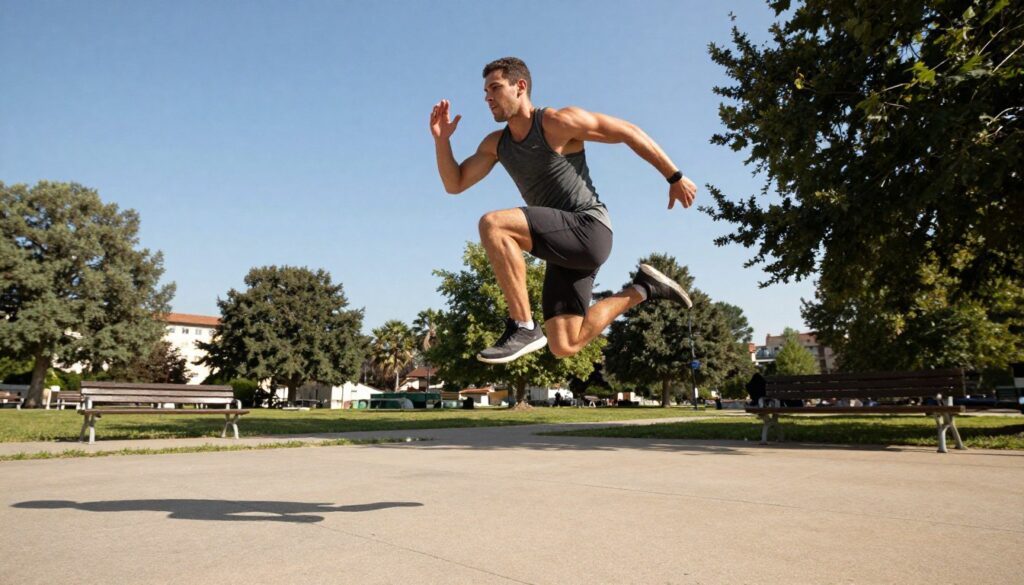
The key is intent. Every jump should be explosive but controlled. You’re not just jumping; you’re jumping with purpose. Land softly, absorb the impact, and get ready to jump again. Quality is more important than quantity here.
Begin safely and progress wisely. Doing too much too soon is a common error. Here’s a simple plan to build power safely:
- Phase 1: Two-Footed Jumps. Start with squat jumps or low box jumps. Focus on quick, powerful hip and knee extension.
- Phase 2: Single-Leg Hops. Move to hopping on one leg, then forward and backward. This builds single-leg stability and power.
- Phase 3: Bounding. Use long, powerful strides for distance. Think “float and push.” This mimics the running motion.
- Phase 4: Hill Sprints. The ultimate power builder for running. Find a moderate incline and sprint for 8-12 seconds with full recovery.
Hill sprints are special. They work your glutes and hamstrings hard while being easy on your joints. Start with 2-3 repeats a week, focusing on perfect form. This is key for strength training for runners seeking speed.
Adding these exercises will change your running. The heavy feeling will turn into a light, powerful glide. Your feet will be on the ground less, and you’ll have more energy for that final push. Are you ready to boost your speed?
Core: anti‑rotation/anti‑extension circuit
Forget about crunches; the real secret to a runner’s strong core lies in resisting movement, not creating it. Your abs aren’t just for show. They form a critical stabilizer that keeps your form tight mile after mile.
Think of your torso as a sealed cylinder running from your ribs to your hips. When you run, powerful forces try to twist it or make it sag. A weak core lets that happen, wasting energy and straining your back. A strong one locks everything down.
This is where anti-rotation and anti-extension training shine. Anti-rotation stops your upper body from twisting excessively with each arm swing. Anti-extension prevents your lower back from arching downward, even when you’re tired.
Including this type of core work in your strength training for runners routine builds a rock-solid foundation. It lets your legs and arms move with power because they’re anchored to a stable base.
Let’s break down a simple, effective circuit. Perform each exercise back-to-back with minimal rest. This builds endurance and stability, just like running does.
The Pallof Press is the superstar of anti-rotation. You stand sideways to a cable or resistance band and press the handle straight out from your chest. The band tries to twist you, but you must brace your core and resist. It teaches your body to stay tall and neutral.
The Dead Bug is a perfect anti-extension drill. Lying on your back, you slowly lower opposite arm and leg while keeping your lower back flat on the floor. It trains your core to stay braced even as your limbs move, mimicking the running gait.
Plank variations are classics for a reason. A standard front plank fights extension. A side plank challenges rotation from the side. Hold these positions with perfect form to build incredible staying power.
Here’s a quick guide to structure your core circuit. Aim for control and quality over speed.
| Exercise | Type | Primary Muscles Worked | Recommended Sets & Reps |
|---|---|---|---|
| Pallof Press | Anti-Rotation | Obliques, Transverse Abdominis | 3 sets of 10-12 reps per side |
| Dead Bug | Anti-Extension | Rectus Abdominis, Deep Core | 3 sets of 8-10 reps per side |
| Front Plank | Anti-Extension | Entire Core, Shoulders | 3 sets of 30-60 second holds |
| Side Plank | Anti-Rotation | Obliques, Glute Medius | 3 sets of 20-40 second holds per side |
| Bird Dog | Anti-Rotation & Extension | Lower Back, Glutes, Core | 3 sets of 8-10 reps per side |
This circuit doesn’t take long. You can do it after your runs or on your strength training for runners days. The payoff is huge. You’ll feel more “connected” and controlled on the road.
A stable core makes you a more efficient runner. It protects your spine and helps transfer force from your legs to the ground. Think of it as the silent partner in every successful running program.
So, trade those endless sit-ups for these smarter moves. Your running form—and your race times—will thank you.
2‑Day and 3‑Day Weekly Plans (Off/In‑Season)
Your time is valuable, so we’ve made 2-day and 3-day strength splits easy. We’ve put all the exercises into a schedule you can follow.
A 2-day split is perfect and sustainable for most runners, even during race season. Studies show two strength sessions a week, with at least 48 hours in between, improve speed and prevent injuries without overloading your schedule.
This two-day plan covers all the basic movement patterns. It balances your key running days well. Here’s a sample weekly layout for an in-season 2-day split:
| Plan Type | Best For | Weekly Schedule | Key Focus |
|---|---|---|---|
| 2-Day Split | In-Season / Race Training | Day 1: Lower Body Focus (Squat, Single-Leg RDL) + Core Day 3: Upper Body & Power (Push, Pull, Jumps) + Core Keep 48+ hours between sessions. |
Maintenance, power, and injury resilience. Taper volume 7-10 days before a goal race. |
| 3-Day Plan | Off-Season / Base Building | Day 1: Foundational Lifts (Squat, Hinge) Day 3: Single-Leg Focus & Core Day 5: Power & Upper Body Spread sessions throughout the week. |
Building a robust muscular foundation. Perfect when running mileage is lower. |
Notice how the two sessions are spaced apart. This allows your muscles to recover and adapt. It also fits around your hard running workouts. As you approach a race, taper these sessions by reducing weight or reps about a week out.
In the off-season, when running volume drops, you can build a stronger foundation. A 3-day weekly plan is great here. The extra session lets you focus more on form and weaknesses.
The sample 3-day layout in the table rotates exercise priorities. This prevents boredom and promotes balanced development. With fewer miles, you can handle more strength work without feeling drained.
Your choice depends on your current phase. Are you deep in marathon training? Stick with the efficient two-day plan. Are you building your base after a break? The three-day schedule can accelerate your progress.
Both plans make programming easy. Just follow the schedule, focus on good form, and balance them with your key runs. The consistency you build will pay off more than any sporadic, intense gym session.
Recovery & mobility flow
Active recovery and targeted mobility work are key to avoiding injuries. Think of strength sessions as a blueprint for a stronger body. Recovery is the crew that builds it! Skipping this phase can lead to plateaus or injuries.
This isn’t about being lazy. It’s about being smart. A dedicated recovery and mobility flow eases muscle tension. It improves your range of motion and gets you ready for your next run feeling refreshed.
Your Post-Run Mobility Flow
Try this simple 10-minute routine after your strength workouts or harder runs. Focus on smooth, controlled movements—no bouncing!
| Exercise | Target Area | Duration/Reps | Key Benefit |
|---|---|---|---|
| Walking Hip Circles | Hips & Glutes | 10 circles per side | Lubricates hip joint, reduces stiffness |
| Standing Hamstring Stretch | Hamstrings | Hold 30 seconds per leg | Improves stride length, eases tightness |
| Downward Dog Calf Stretch | Calves & Achilles | Hold 45 seconds, pedal feet | Prevents calf strains, promotes ankle mobility |
| Pigeon Pose (or Figure-4 Stretch) | Deep Hip Rotators | Hold 45 seconds per side | Relieves sciatic tension, a major injury prevention move |
| Deep Squat Hold | Full Lower Body | Hold 60 seconds | Resets posture, enhances mobility for lifts |
Consistency with this flow is key. For more advanced mobility drills to help you run, explore dedicated routines that build on these basics.
Fuel the Repair Process
Mobility is one piece. Your body needs raw materials to rebuild. Sleep is non-negotiable—aim for 7-9 hours. During deep sleep, growth hormone releases, repairing muscle tissue.
Hydration transports nutrients and flushes waste. Drink water consistently throughout the day, not just during workouts.
Nutrition provides the building blocks. A post-workout snack or meal with protein (like Greek yogurt) and carbs (like fruit) within 45 minutes kickstarts recovery.
Recovery Tools & Smart Gear
Sometimes, your muscles need a little extra help. Foam rolling is like a self-massage. It breaks up tight knots and improves blood flow to sore areas like quads and IT bands.
Compression gear, like tights from brands such as CW-X, can also play a role. Studies suggest they may reduce muscle vibration and fatigue during activity, leading to less soreness afterward. Think of them as supportive tools for your circulatory system, aiding recovery.
Even your training schedule should have recovery built in. This includes regular deload weeks and tapering your volume before a race. Reducing mileage allows your body to fully absorb the training and peak on race day.
By making recovery a priority, you’re not just resting. You’re actively engaging in a powerful injury prevention strategy. You’re building a resilient body that can handle more miles and heavier weights, season after season.
Nutrition for strength + runs
Merging strength work with your running schedule puts a lot of demand on your body. The key to meeting this demand is in the kitchen. Getting your nutrition right is essential for your running performance and muscle gains.
Let’s simplify it. Food has two main jobs for athletes like you.
Carbohydrates are your main fuel. They power your runs and refill your energy stores. Protein, on the other hand, is for building and repairing muscles.
Timing your food intake is critical. Eating the right thing at the right time boosts your energy and aids in recovery. It’s that simple!
This table offers a clear plan for strategic fueling. It outlines what to eat before and after your key sessions.
| Session Focus | Primary Goal | Timing | Food Examples |
|---|---|---|---|
| Pre-Run (Especially Long or Hard) | Maximize fuel availability | 1-3 hours before | Oatmeal with banana, whole-grain toast with honey, a small bagel |
| Pre-Strength Training | Sustain energy for lifting | 1-2 hours before | Greek yogurt with berries, an apple with peanut butter, a small rice cake |
| Post-Workout (After any hard session) | Repair muscles & replenish fuel | Within 45-60 minutes | Chicken with sweet potato, protein shake with a banana, quinoa bowl with veggies and tofu |
Before activity, focus on carbs for energy. After, mix protein with carbs to rebuild and refuel. It’s not about a strict diet.
It’s about making smart choices that support your goals. A carb-rich snack before a long run prevents the “bonk.” A protein-rich meal after a heavy lift helps your muscles grow stronger.
By following these simple principles, you give your body what it needs. You’ll recover faster, feel stronger, and see steady improvement in your running performance. Remember, consistency with your diet is as important as consistency with your training!
Desk/gaming posture resets (5‑minute routine)
The modern desk job is a big challenge for runners. Sitting for hours trains your body against your running goals. You get tight hip flexors, sleepy glutes, and a rounded back.
This posture takes power and efficiency from your stride.
But there’s good news! A simple 5-minute reset can help. It’s not a workout but a posture reboot. Doing it a few times a day keeps your muscles ready.
Your goal is to break up long sits with this quick routine. It combines stretches and activation drills. Focus on hip stability and glute activation—key for strong running.
| Exercise | Focus Area | How-To | Time |
|---|---|---|---|
| Seated Hip Flexor Stretch | Front of Hips | Scoot to the front of your chair. Extend one leg back, knee on floor (or a cushion). Gently tilt pelvis forward until you feel a stretch in the front of your hip. Hold. | 45 sec per side |
| Thoracic Extension over Chair | Upper Back & Chest | Sit tall, lace fingers behind your head. Gently arch your upper back over the chair back, opening your chest toward the ceiling. Keep your lower ribs down. | 60 seconds |
| Glute Bridge March | Glute Activation | Lie on your back, knees bent, feet flat. Lift hips into a bridge. Hold the top position and slowly lift one knee toward chest, then lower. Alternate. | 60 seconds |
| Seated Scapular Retraction | Mid-Back & Posture | Sit tall away from the backrest. Squeeze your shoulder blades together and down, as if trying to hold a pencil between them. Release slowly. | 45 seconds |
Notice how the table moves from stretching to activating? That’s the magic. You’re first lengthening tight muscles, then firing up lazy ones. For another great way to break up sitting, try this quick chair exercise to combat back pain and engage your core right at your workstation.
Do this routine mid-morning and mid-afternoon. It takes almost no space and zero equipment. Regular practice makes you feel loose and powerful for your run. You’re not just building strength in the gym; you’re protecting it all day long.
Common mistakes & form cues
The biggest obstacle in strength training isn’t lack of effort. It’s small form errors that sneak in. When focusing on lifting for runners, proper technique is more important than the weight. Good form builds the right muscles, protects your joints, and helps on the road.
Everyone makes mistakes when starting. That’s okay! The key is to spot them early and have simple fixes ready. These fixes are called “form cues.” They are short phrases that help your body find the right position.

Let’s talk about a big scheduling mistake. Never do a heavy leg session before a key speed workout or long run. Your muscles need energy and freshness for that run. Schedule your hard lifts and runs on different days, or easier runs after strength sessions.
Now, let’s fix your form. The table below lists common errors and how to correct them. Remember, a controlled tempo and full range of motion are key for building strength.
| Common Mistake | Why It Happens | Simple Form Cue | Visual Check |
|---|---|---|---|
| Rounding the lower back (Deadlift/RDL) | You’re pulling with your arms instead of driving with your legs and hips. | “Chest up, hips back.” Imagine you’re showing a logo on your shirt to someone in front of you. | Keep a neutral spine. Your back should look like a straight line from head to hips. |
| Knees caving in (Squat, Step-up) | Weak glutes and tight hips cause the thighs to rotate inward (knee valgus). | “Push the floor apart with your feet.” Screw your feet into the ground. | Your knees should track in line with your second and third toes. |
| Shallow range of motion | Fear of losing balance or using too much weight limits the movement. | “Control the descent, feel the stretch.” Go as deep as you can with good form. | Aim for thighs parallel to floor in squats, or a light tap on the floor for RDLs. |
| Rushing the rep | Focusing on finishing the set instead of the quality of each lift. | “Two seconds down, one second up.” Count it out in your head. | The movement should look smooth, not bouncy or jerky. |
| Holding your breath | Concentrating so hard on the movement that you forget to breathe! | “Exhale on the effort.” Breathe out as you push or pull the weight. | Your face shouldn’t turn red. Steady breathing keeps your core stable. |
Start practicing these cues with little or no weight. It’s like learning a new skill. “Chest up, hips back” and “push the floor apart” are more than phrases. They activate the right muscles and build patterns for strength and resilience.
Mastering these basics is a smart investment in your lifting for runners journey. It ensures every rep helps your speed and injury prevention. The weight room becomes your secret performance weapon.
12‑week progression roadmap
This 12-week roadmap is your guide to a stronger, more resilient running body. Just like you need a plan for a marathon, your runner strength workouts need structure for lasting change. We’ve divided this journey into three phases, each with a specific goal.
This phased approach helps your body adapt, leading to continuous gains in speed, economy, and durability.
The secret is progressive overload. It means getting stronger by gradually increasing the challenge for your muscles. We’ll increase weight, reps, or speed every few weeks. Let’s build your plan together.
Your goal is mastery, not max effort. This phase focuses on neuromuscular adaptation. It teaches your brain and muscles to work together perfectly. You’ll do bodyweight or very light exercises.
Key exercises include bodyweight squats, hinges, push-ups, and planks. Do 2-3 sets of 12-15 reps, moving with control. Success is about feeling stable and confident in every movement.
Phase 2: The Strength Builder (Weeks 5-8)
Now we add load! With your form locked in, you’ll increase the weight on foundational lifts. This phase builds the muscular strength that supports your running stride. Exercises include weighted goblet squats, dumbbell Romanian deadlifts, and rows.
Your rep range drops to 8-10, allowing for heavier weights. The rule is to add a little more weight when you can complete all reps with good form.
Phase 3: The Power Transfer (Weeks 9-12)
This phase combines strength with speed. You’ll apply the force you’ve built quickly, improving your stride. Your runner strength workouts will include explosive movements like box jumps, medicine ball throws, and weighted hill sprints.
You’ll use moderate weight for low reps (3-6) but move with intent and speed. The focus is on quality, not fatigue.
Following this roadmap turns random exercises into a powerful sequence. The Foundation phase ensures safety and efficiency. The Strength phase builds your engine. The Power phase teaches that engine to rev high.
After 12 weeks, you’ll be stronger in the gym and feel a tangible spring and stability in every run. You’ll be amazed at how structured effort transforms your running experience.
FAQs
You’ve got questions, and we’ve got clear, evidence-based answers to help you train smarter. Let’s dive into the most common curiosities and concerns runners have about strength training.
No, you’re not turning into a bodybuilder! The strength work for runners builds lean, functional muscle. This muscle supports your joints and makes your stride more efficient. You become a more powerful, resilient, and faster runner.
How heavy should I actually lift?
Focus on control and technique first. Once your form is solid, aim for a weight that makes the last 2-3 reps of a set challenging but doable with good form. For most foundational lifts, 8-12 reps is a great range. This builds strength without excessive mass. Remember, progressive overload is key—gradually adding a little more weight or an extra rep over time signals your body to get stronger.
Is a 2-day split enough to see real results?
Yes, a consistent 2-day split is an excellent and sustainable starting point for most runners. Two full-body sessions per week provide a potent stimulus for building strength and supporting your tendons and ligaments. This frequency is often perfect for balancing running volume while making significant gains in injury prevention. For many, it’s the sweet spot between effectiveness and recovery.
What if I’m too sore to run after lifting?
Some soreness is normal, but it should not stop you. Schedule your strength sessions on your easy run days or rest days. Always do your strength work after an easy run, not before a hard workout. If you’re extremely sore, prioritize gentle mobility and maybe swap a run for a walk. This soreness (called DOMS) decreases as your body adapts.
When is the best time to schedule strength training?
The ideal time is on an easy run day, after your run. This keeps your hard running days truly hard and your easy days focused on supportive work. If you must train on a rest day, that’s okay too! The golden rule: avoid heavy lifting the day before a key speed workout or long run. Proper scheduling is a cornerstone of effective injury prevention.
What type of strength training is best for runners?
Runners benefit most from a mix: foundational lifts (squats, hinges), single-leg work (like split squats), and power movements (jumps). This combination builds overall strength, addresses muscle imbalances specific to running, and improves your explosive power for hills and finishes. Our plans in Section 9 put this perfect blend together for you.
We hope these answers clear the path for you. Remember, adding strength is one of the smartest investments you can make in your running journey. A simple 2-day split can be your secret weapon for longevity and performance!
Conclusion
Your running journey now has a powerful new component. Strength training for runners is not just extra work. It’s the key that boosts your running performance.
You have everything you need. You know how to check your movement and do basic lifts. You also know how to improve your balance and strengthen your core.
Adding tools like compression wear can help with recovery. This makes your training even more effective.
The journey ahead is about being consistent, not perfect. Start with one or two exercises each week. Pay attention to how your body feels.
Small, regular strength training efforts lead to big gains. You’ll run faster and feel better.
We’re here to help you get stronger and faster. Your next personal best is waiting. Now, get ready to run with renewed strength.