
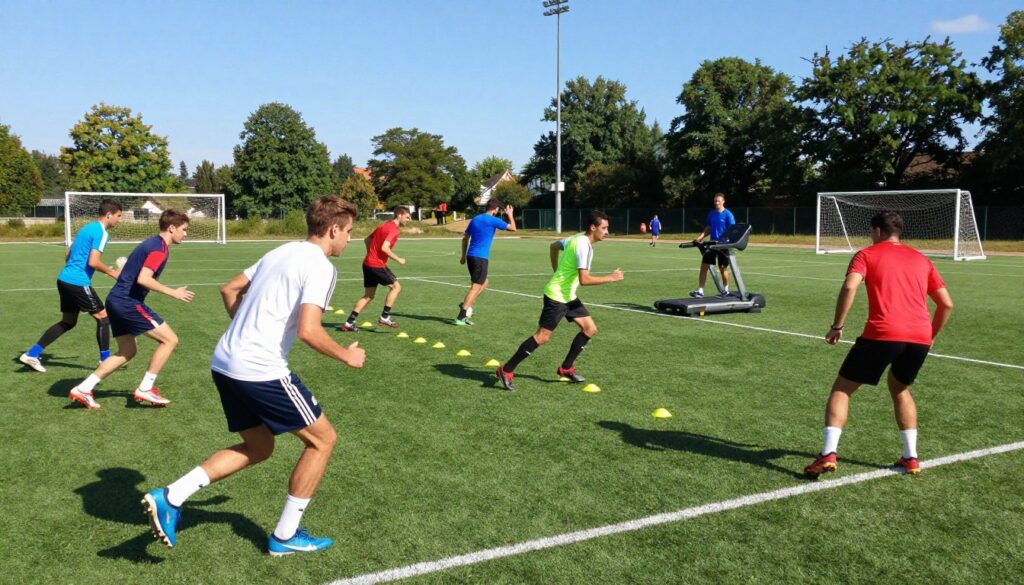
Have you ever watched a high-level match and marveled at the players? Their endless energy, blistering speed, and razor-sharp agility aren’t just natural talent. That’s the power of targeted soccer conditioning.
This isn’t about mindlessly running laps. It’s about training your body to meet the specific, intense demands of the modern game. Think of it as upgrading your engine and fine-tuning your chassis for peak performance on the pitch.
Today’s football requires explosive acceleration, high top speed, and quick changes of direction. To build this, players focus on fast-twitch muscles with specific football fitness drills, 2-3 times per week. This becomes critically important as the game gets faster, at competitive levels like U-14 and beyond.
We’re here to guide you through that process. This guide will break down everything from foundational fitness for your position to the exact exercises that build game-ready speed, endurance, and agility. Whether you’re starting out or aiming for the next level, we’ll make these concepts clear and actionable for you.
Positional demands & metrics
Think of your soccer position as a unique job description—each role has its own fitness checklist. A central defender and a winger might play the same sport, but their physical needs are worlds apart! Understanding this is your first step to training smarter, not just harder.
Let’s break it down. Forwards are your team’s lightning bolts. They need explosive acceleration to beat defenders off the line and a high top speed for those thrilling breakaways. Think of a winger sprinting 30 yards to chase a through ball—their key metrics are pure speed.
Midfielders are the engines. Their game is constant motion. They require repeat sprint ability (RSA) to make run after run and superior agility for quick turns and evasive moves. Total distance covered is important, but the quality of that distance—how much is at high intensity—matters more.
Defenders need reactive power. They must mirror attackers, which demands sharp agility and powerful, short bursts of acceleration to close down space or make a critical tackle. Their success often hinges on winning those first few explosive steps.
| Position | Key Physical Demands | Primary Metrics to Track |
|---|---|---|
| Forward / Winger | Explosive acceleration, maximum speed | 20-30 yard sprint time, top speed (mph/kmh) |
| Central Midfielder | Repeat sprint ability, agility, aerobic endurance | Sprint repeatability score, total high-speed distance, changes of direction per game |
| Defender (Center-back & Full-back) | Powerful acceleration, reactive agility, strength | 10-yard acceleration time, agility test times (e.g., 5-10-5 drill) |
So, how do you find your blueprint? Ask yourself: What does my position ask me to do most? Is it the number of sharp changes of direction? Or the distance I cover at a high-speed threshold?
By tailoring your conditioning to these specific demands, you focus your energy where it counts. You’re not just getting fit; you’re building the exact fitness your position requires. This targeted approach is what separates good players from great ones on the pitch.
RAMP warm‑up protocol
Think of your body like a high-performance sports car. You wouldn’t start it cold, and the same goes for your training. A proper warm-up is non-negotiable, vital for growing athletes. It prevents injuries and unlocks your full speed and power.
The RAMP protocol is used by pros because it prepares you fully. RAMP stands for Raise, Activate, Mobilize, and Potentiate. Let’s explore each phase to see why it’s effective.
- Raise
This phase is like preheating your engine. You aim to gently raise your heart rate, blood flow, and body temperature. This makes your muscles soft and ready to move.
- Light Jogging (3-4 minutes)
- High Knees
- Butt Kicks
- Activate & Mobilize
Next, we wake up and prepare your muscles and joints. We use dynamic movements that mimic soccer actions, not static stretches.
- Walking Lunges with a Torso Twist (engages hips and core)
- Forward and Side-to-Side Leg Swings (mobilizes hips and hamstrings)
- Large Arm Circles (loosens shoulders for throwing and balance)
- Potentiate
This final step primes your nervous system for explosive efforts. The drills here are sport-specific and dynamic.
- Lateral Shuffles (for side-to-side agility)
- Skips for Height (develops power)
- Light Bounding (practices forceful push-offs)
This 2-3 minute phase prepares you for your HIIT for soccer session.
Make sure to do this 8-10 minute RAMP routine before every session. It’s not wasted time; it’s invested time. You’re building a foundation of safety and readiness. This makes every sprint sharper and every cut more confident. Starting with discipline is what makes your HIIT for soccer training effective and sustainable.
Acceleration & Max‑Speed Drills (A‑Runs, Wickets)
Ready to fire your engines? Acceleration and max-speed training are where raw power meets technical precision. This is your blueprint for building the explosive first step and blistering top-end pace that defines modern soccer.
Let’s break it down. Acceleration is your ability to reach maximum speed as quickly as possible. It’s that lightning burst from a standing start, a jog, or even the ground that lets you beat an opponent to a 50/50 ball. Think of it as your body’s launch sequence.
To build this rocket-like quality, we use drills that mimic game situations. Here are the most effective acceleration builders:
- Sprint Starts: Practice exploding from different positions—standing, kneeling, or even lying down. This teaches your body to generate force from any angle.
- Resisted Sprints: Using a light resistance band harnesses your power, forcing you to drive harder against the ground. When the band comes off, you’ll feel explosive!
- Falling Starts: Simply lean forward until you’re forced to catch yourself with a powerful step. This drill ingrains the forward body lean and positive shin angle needed for horizontal propulsion.
- Half Kneeling Starts: Starting from one knee up and one knee down builds unilateral strength and stability, vital for changing direction.
- Cone Start/Stop Drills: Place cones 5-10 yards apart. Sprint to a cone, decelerate quickly, then immediately re-accelerate. This builds the stop-and-go power vital for soccer.
Once you’re up to speed, you need to hold it. That’s where max-velocity (top speed) drills come in. Here, the focus shifts from raw power to perfect mechanics. Efficient form makes you faster and conserves precious energy for sprint repeatability later in the game.
Top-speed work is all about rhythm and technique. Essential drills include:
- A-Skips & B-Skips: These classic drills teach proper knee drive (triple flexion) and a powerful, cycling leg action. They’re the ABCs of sprinting.
- Straight Leg Bounds: Focuses on generating power through your glutes and hamstrings, teaching you to “pull” the ground behind you.
- Flying Sprints: Build speed over 15 yards, then strive to hold that max velocity for another 15 yards. It isolates the top-speed phase perfectly.
- Wicket Drills: Also called “A-Runs,” spacing small hurdles (wickets) at precise intervals forces optimal stride length and frequency. It’s like reprogramming your sprinting gait for efficiency.
Remember, in a match, you might only hit your absolute top speed a handful of times. But when you do, you want to be fast, smooth, and efficient. By dedicating time to both acceleration and max-speed mechanics, you’re not just getting quicker—you’re building a resilient engine capable of repeated, high-quality efforts. That’s the true secret to dominating the final minutes when others are fading.
Change of direction & agility patterns
If straight-line speed is the engine of a soccer player, then agility is the steering wheel and brakes combined. Soccer isn’t played on a track. The magic happens in sharp cuts, sudden stops, and explosive shifts in direction to lose a defender or stick with an attacker.
True agility means changing direction quickly and under control. We can split it into two types: planned changes (like a pre-meditated cut around a cone) and reactive changes (responding to an opponent’s move). Your training should include both.
Let’s break down four fantastic drills that look and feel just like movements on the field. You’ll love how they translate directly to game day.
- Zig-Zag Sprints: Set cones 5 yards apart in a zig-zag line. Sprint to each cone, planting your outside foot firmly to push off into the new direction. This teaches you to maintain speed while cutting. The key is a strong plant and driving off that leg without standing up tall.
- The Mirror Drill: Grab a partner and face each other in a small 5×5 yard box. One leads with lateral shuffles, quick steps, and direction changes; the other mirrors them exactly. This is fantastic for reactive agility and defensive footwork. Stay low in an athletic stance, ready to pounce.
- The T-Drill: This classic tests multiple movement patterns. Sprint forward 10 yards, shuffle 5 yards left, shuffle 10 yards right, shuffle 5 yards back left, then backpedal to the start. It combines linear speed with lateral agility and backward movement, building all-around coordination.
- The “Figure of M” Exercise: Create a pattern with cones that looks like a blocky “M.” Weave through it at high intensity, focusing on tight turns and accelerating out of each corner. It mimics the unpredictable, multi-directional runs you make during a match.
For every drill, remember the golden rule: stay low. Bend your knees, keep your chest up, and maintain a stable center of gravity. This is your ready-to-pounce position. Mastering these patterns builds the footwork and confidence to dominate those one-on-one battles.
Aerobic Power Sets (4×4, Tempos)
Sprints and agility get all the attention, but your aerobic power is key. It’s how well your body uses oxygen when you’re working hard. A strong aerobic system lets you keep going strong from start to finish.
Think of it as your endurance base. Scientists measure it as your VO2 max. A higher VO2 max means you can push harder for longer and bounce back quicker.
So, how do we build it? A top method is HIIT for soccer called the “4×4” protocol. Here’s how it works:
- Run hard for 4 minutes. Aim for 90-95% of your maximum heart rate—a pace where talking in full sentences is difficult.
- Follow that with 3 minutes of active recovery, like a slow jog or brisk walk.
- Repeat this cycle four times total.
It’s tough, but it boosts your oxygen delivery system. This raises your VO2 max.
We also use “tempo runs” to add to the challenge. A tempo run is a steady effort at a pace where you can say short phrases but not chat easily.
This pace trains your lactate threshold. It’s like teaching your body to clear fatigue-causing byproducts more efficiently. It helps your engine handle high speeds without overheating.
| Training Focus | How It Works | Key Benefit for Soccer |
|---|---|---|
| 4×4 Interval Protocol | 4 min hard run (90-95% max HR) + 3 min active recovery. Repeat 4x. | Maximizes improvements in VO2 max and anaerobic capacity. Perfect HIIT for soccer to simulate game-intensity bursts. |
| Tempo Run | 20-30 minute sustained run at a “comfortably hard,” steady pace. | Raises lactate threshold, allowing you to maintain a higher sub-maximal speed without fatigue building up quickly. |
The 4×4 and tempo runs are a powerful combo. The 4×4 raises your ceiling, while tempo runs strengthen your foundation. Together, they build the strong, efficient engine every soccer player needs.
Sprint Repeatability (RSA Intervals)
Sprint repeatability isn’t about how fast you can go once; it’s about how often you can hit that top speed when it matters most. It’s like your engine’s durability. Anyone can sprint fast at first. But the real challenge is doing it again and again, even when tired.
This skill is called Repeat Sprint Ability (RSA). It’s key for midfielders and fullbacks who switch from defense to attack often. Your RSA score shows how well you perform from your first to your last sprint.
So, how do we build it? Through specific, challenging interval sessions. A classic RSA drill looks like this:
- Repetitions: 6 to 8 sprints
- Distance: 30 to 40 meters (about 33 to 44 yards)
- Rest: Only 15 to 30 seconds between efforts
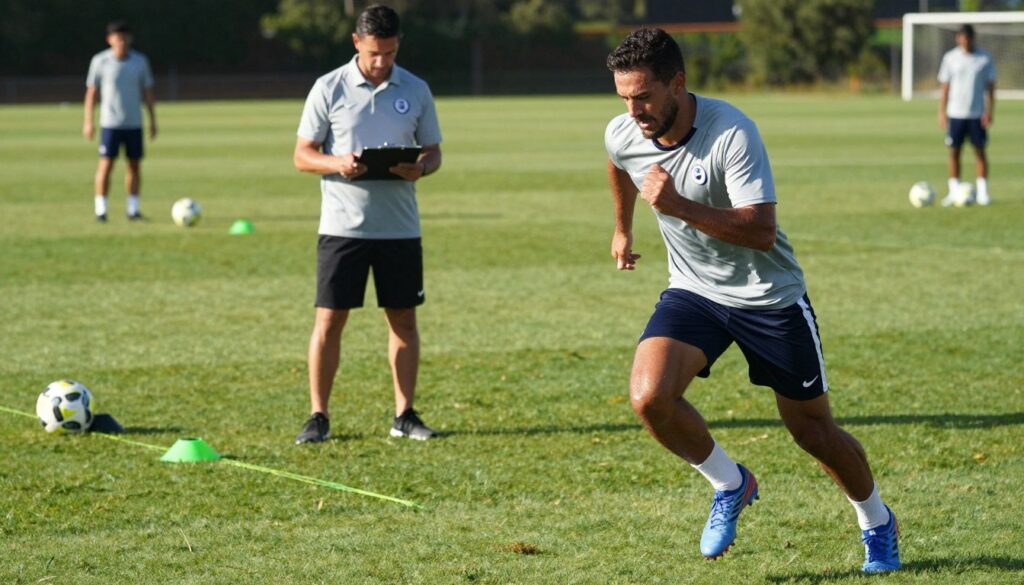
That short rest is intentional and brutal. It forces your body to operate at and push past its lactate threshold. This is the point where fatigue-causing metabolites build up faster than your body can clear them. By training here, you adapt.
Your muscles become more efficient at buffering acid, and your heart gets better at delivering oxygen-rich blood during brief pauses. You effectively raise your lactate threshold. This means you recover quicker between those high-intensity bursts on the field.
The payoff is immense. When it’s the 85th minute and legs are heavy, your sprint repeatability lets you make that overlapping run or track back to defend. You’re not just fit; you’re specificially conditioned for the decisive moments.
Small‑sided games and work:rest ratios
Forget the monotony of laps around the track. The most engaging soccer conditioning happens with a ball at your feet and teammates by your side. Small-sided games (like 3v3 or 4v4) are the ultimate two-for-one training tool. They build your fitness while sharpening the very skills you use in a match.
Why are they so effective? These games force you into constant decision-making, sharp turns, and short, explosive sprints. You’re not just running; you’re playing. This replicates the sport’s natural movement patterns in a way isolated drills simply can’t. The fun factor is a major bonus—you’re more likely to push your limits when you’re competing.
To use these games for targeted conditioning, we manipulate two main “dials”: the size of the pitch and the work:rest ratio. Getting these right tailors the fitness stimulus to your specific needs.
First, let’s talk pitch size. A small, tight area creates a high “work” ratio. You’re almost always involved, with lots of quick touches and changes of direction. It’s great for anaerobic endurance and neuromuscular coordination. A larger pitch space allows for longer sprints and slightly more recovery between actions. This shifts the focus more toward aerobic capacity and repeated sprint ability.
Second, we structure the play time. Instead of playing straight through, we use timed intervals. For example, you might play at full, match-like intensity for 90 seconds, then have a controlled 45-second rest period. This 2:1 work:rest ratio is a classic for building soccer-specific endurance. You can adjust these clocks to emphasize pure speed (shorter work, longer rest) or relentless stamina (longer work, shorter rest).
The table below shows how different formats create unique conditioning challenges:
| Game Format | Recommended Pitch Size | Sample Work:Rest Ratio | Primary Fitness Emphasis |
|---|---|---|---|
| 3v3 (High Intensity) | 30 x 20 yards | 1 min on / 1 min off | Anaerobic power, quick decision-making |
| 4v4 (Mixed Demand) | 40 x 30 yards | 2 min on / 1 min off | Soccer-specific endurance, support play |
| 5v5 (Aerobic Focus) | 50 x 40 yards | 4 min on / 2 min off | Aerobic capacity, positional awareness |
| Coached Interval | Varies | 45 sec on / 30 sec off | Sprint repeatability, recovery under fatigue |
The magic happens when fitness and skill collide. By practicing your passing, dribbling, and shooting under the fatigue of these intense games, you train your body and mind for the final minutes of a real match. This is the ultimate test of game readiness. For a deeper dive into the science and application, this practical guide to small-sided games offers excellent frameworks.
So, next time you think about conditioning, grab a few friends, set up some small goals, and turn fitness into your most enjoyable training session. Your game will thank you for it.
In‑season vs off‑season weekly templates
Think of your fitness like building a house. The off-season is for laying the foundation and raising the walls. The in-season is about maintaining the structure and keeping it strong. Your weekly training template must change with these phases to build athleticism safely and effectively.
During the off-season, you have the luxury of time. The focus is on building a broad fitness base, improving weaknesses, and adding supportive muscle. This is your chance to commit to 3-4 dedicated conditioning sessions each week. You can recover fully between them because matches aren’t demanding your energy.
Once the in-season starts, the priority flips. Now, the main goal is maintaining your hard-earned fitness while recovering for weekend matches. Conditioning often gets reduced to 1-2 short, sharp sessions per week. We frequently weave these right into practice, like a block of intense football fitness drills after light technical work.
The golden rule, for growing U-14 athletes, is quality over quantity. A tired player with poor form won’t get faster—they risk injury or burnout. Always prioritize rest days between your most intense sessions.
| Seasonal Phase | Primary Focus | Conditioning Sessions/Week | Integration with Practice |
|---|---|---|---|
| Off-Season | Build foundation, address weaknesses, develop strength. | 3-4 | Dedicated, stand-alone sessions with full recovery. |
| In-Season | Maintain fitness, prioritize match recovery, support performance. | 1-2 | Often integrated into mid-week training after light technical drills. |
So, what does this look like in a practical weekly plan? For U-14 players, we recommend speed and agility work 2-3 times per week. Do this work before technical training when your legs are fresh. Here’s a sample off-season week focused on these football fitness drills:
| Day | Primary Drill | Secondary Drill | Key Notes |
|---|---|---|---|
| Day 1 | Sprint Starts | Cone Box Drill | Focus on explosive first steps and sharp 90-degree turns. |
| Day 2 | Flying Sprints | Zig-Zag Drill | Build top speed and practice changing direction at pace. |
| Day 3 (Optional) | Resisted Sprints | Mirror Drill | Build power and reactive agility. Always take a rest day after. |
Remember, this weekly plan is a template, not a rigid command. Listen to your body. If you feel overly fatigued, an optional day can become a rest day. The seasonal mindset—building in the off-season, maintaining in-season—is your true guide to smarter, safer progress.
Monitoring (RPE, HR, GPS-lite alternatives)
Training without monitoring is like driving blind. You might move, but you don’t know where or how fast. To train better, we need to listen to our bodies with simple tools.
Monitoring acts as your personal training guide. It turns feelings of tiredness into useful data. This lets you adjust each workout to fit your fitness level and avoid overtraining.
You don’t need fancy gear to monitor your training. We’ll look at three easy methods: how you feel, your heart rate, and basic tracking for speed and distance.
Your brain is the simplest tool. The Rating of Perceived Exertion (RPE) scale asks how hard you felt a drill was. A 1 is easy, and a 10 is extremely hard. Aim for an 8 or 9 in tough intervals. It’s easy and doesn’t need any gadgets.
A heart rate monitor offers more precise feedback. It shows your intensity zone. This is key for boosting your VO2 max. Seeing your heart rate helps measure your effort.
At the top level, teams use GPS vests for player tracking. But you can use simpler “GPS-lite” methods for personal training.
Use a stopwatch for sprint intervals and rest. Free apps can track your distance on runs. The aim is to get numbers to compare each week.
Monitoring’s true strength is in using the data. It turns workouts into training with a goal. By tracking RPE, heart rate, or times, you ensure steady progress and build your aerobic capacity for the full game.
Recovery & mobility checklist
Think of your body like a high-performance car. The workout is the race, but recovery is the essential pit stop. It keeps you running at peak speed. Pushing hard in training breaks your muscles and systems down. It’s during the rebuild phase that you actually get fitter, faster, and stronger.
A smart recovery plan is non-negotiable. This checklist turns rest into an active strategy. Follow it to bounce back quicker, reduce soreness, and build a body that can handle more intense training.
Here’s your personal game-day recovery checklist. Treat these steps as seriously as your drills.
- Cool-Down (5-10 minutes): Never just stop! Finish with a light jog and walking. Then, hold static stretches for your quads, hamstrings, calves, and hips. This helps clear metabolic byproducts (like lactate) from your muscles and improves flexibility for your next session.
- Rehydrate Immediately: Replace the fluids you sweated out. Water is perfect. For intense sessions, an electrolyte drink can help restore balance.
- Refuel Within 45 Minutes: This window is golden. Your muscles are craving nutrients to start repair. Aim for a mix of protein and carbs. A chocolate milk, a yogurt with fruit, or a protein smoothie are all excellent, easy choices.
- Prioritize Sleep (8-10 hours): This is where the major repair happens! Growth hormone is released during deep sleep, repairing tissues and consolidating the gains from your workout. Consider sleep your secret weapon.
- Mobility & Self-Massage (On Off-Days): Use a foam roller or lacrosse ball on your legs and back. This self-myofascial release eases tight muscles, improves blood flow, and maintains your range of motion. It’s like a massage you give yourself.
Why does this checklist matter so much for your lactate threshold? Consistent recovery allows you to train at higher intensities more often. When you’re not battling fatigue and soreness, you can push harder in those aerobic power and sprint repeatability sessions. Over time, this teaches your body to clear lactate more efficiently.
Sticking to this routine manages day-to-day soreness. More importantly, it builds your body’s resilience. You’ll be ready for the next tough practice, which is how you sustainably raise your lactate threshold and overall soccer fitness.
Make this checklist a habit. Your future self on the pitch will thank you for it!
At‑home micro‑sessions for busy/gaming days
Imagine keeping your edge with just 15 minutes and no equipment. That’s the power of a well-designed micro-session. Life gets hectic, rain cancels practice, or you have a big game tomorrow. These aren’t excuses to skip training! Micro-sessions are short, intense workouts you can do anywhere to keep your body primed.
Think of them as a fitness insurance policy. When you can’t access the field or gym, a 15-20 minute blast prevents fitness loss. It maintains the training stimulus your body expects. Your nervous system stays sharp. You prove commitment to your goals, no matter the circumstances.
What does a micro-session look like? It’s all about maximum effort in minimum time. A classic bodyweight circuit is perfect: jump squats for explosive power, alternating lunges for single-leg stability, and plank variations for core strength. Try 30 seconds of work, 30 seconds of rest, repeated for 10 rounds.
No space? Find a staircase! Five all-out sprints up the steps with a slow walk down for recovery builds serious power. If you have an agility ladder, quick-foot patterns enhance coordination. The key is intensity over duration.
| Workout Type | Duration | Equipment Needed | Key Focus |
|---|---|---|---|
| Bodyweight Blast | 15-20 minutes | None | Full-body strength & plyometrics |
| Stair Sprints | 10-15 minutes | Staircase | Power & anaerobic capacity |
| Agility Ladder | 15 minutes | Agility ladder (or tape lines) | Foot speed & coordination |
| Mixed Micro-Circuit | 20 minutes | None | Conditioning & muscular endurance |
These condensed football fitness drills deliver remarkable benefits. They prevent detraining. They keep your metabolism active. They even improve mental toughness by showing you can train under any conditions. Consistency with micro-sessions means you return to full practice stronger, not starting over.
For more structured ideas, check out these home soccer training drills that turn small spaces into effective training grounds. The program includes timing games and reaction exercises that fit perfectly into micro-sessions.
Remember, progress isn’t just about long, grueling sessions. Sometimes, it’s about the smart, intense bursts you complete when life gets in the way. Your next micro-session could be the difference between maintaining fitness and losing a week of hard work. So lace up your shoes, clear a little space, and get after it!
Nutrition & hydration playbook
To reach your best during HIIT for soccer workouts, focus on what happens outside the game. View your body as a top-notch vehicle. Just as a race car needs premium fuel, your body needs the right food and fluids. This guide makes it easy.
Hydration is key. It’s not just for practice. Drink water all day, every day. Water keeps your muscles strong and your mind clear for big game moments.
Before your workout, eat a balanced meal 2 to 3 hours ahead. Choose complex carbohydrates like oatmeal or sweet potatoes for lasting energy. Add lean protein like chicken for extra power without feeling heavy.
After your HIIT for soccer session, refuel quickly. A snack or shake with carbs and protein within 30-60 minutes helps your body recover. It fills up your energy stores and helps muscles heal.
Avoid sugary drinks and processed snacks. They might give a quick boost but cause a crash later. They don’t help with the steady energy needed for soccer conditioning.
Good nutrition is key to all we’re working on. It builds strong muscles, fuels your brain, and lets you do it all again. It’s the base that makes your hard work on the field worth it.
Follow this simple plan: drink water all day, eat well before, refuel fast after, and skip the bad stuff. You’ll notice better energy, faster recovery, and improved performance. Make your fuel as good as your training!
Safety, progressions, and mistakes
Let’s get real: the fastest way to derail your training progress isn’t a missed session—it’s an avoidable injury. Pushing too hard, too fast, can wipe out weeks of work and stall your hard-earned speed and agility. Our goal is to build a durable athlete, not a broken one. That journey starts with a simple, non-negotiable rule.
Form always comes first. Before you chase a faster time or add more weight, you must master the movement pattern. Think of it like learning a language; you need the grammar right before you can write poetry. If you’re stumbling through cones just to beat the clock, you’re practicing mistakes, not performance.
Master the drill slowly and with perfect control. Speed is a layer you add only after the neuromuscular pattern is locked in. This is true, even for complex agility drills. Rushing teaches your body inefficient—and often unsafe—ways to move.
This leads us to the golden rule of progression: add only one challenge at a time. We call this intelligent progression. For example, don’t jump to single-leg bounds until two-footed jumps are easy and stable. Don’t add a weighted vest to a sprint until your running technique is flawless. Your body adapts best when stressed gradually and specific.
Now, let’s tackle the common pitfalls that sideline well-intentioned players. Avoiding these mistakes is just as important as doing the workouts:
- Skipping the Warm-up: The RAMP protocol we discussed isn’t optional. It prepares your tissues and nervous system for work.
- Training Through Pain: Distinguish between muscle fatigue and sharp, acute pain. The former is expected; the latter is a full-stop signal.
- Neglecting Rest: More is not better. Rest is when your body repairs and gets stronger. Overtraining leads to burnout and injury.
- Sacrificing Form for Speed: On agility drills or sprints, clean technique is your top priority, every single rep.
- Comparing Your Journey: Your progress is personal. Comparing your Day 30 to someone else’s Day 300 is a recipe for frustration and bad decisions.
Listen to your body’s signals—it’s your most important coach. Building fitness is a long-term project. By prioritizing safety and smart progression, you ensure you’re improving months from now, not rehabbing an injury. For a safe and effective path, check out these structured soccer workouts designed with these very principles in mind. Patience and consistency will build the lasting speed and agility you’re after.
8‑week sample plan
This 8-week plan combines all drills and concepts into a single, progressive schedule. It’s like building a house: start with the foundation, build the walls, and add the roof for completion.
Your journey is divided into three phases: Foundation, Build, and Game Ready. Each phase prepares your body for the next, ensuring you’re ready when it matters most.
Here’s a week-by-week breakdown. Remember, this is your plan—adjust it as needed based on your schedule and how you feel!
| Phase | Weeks | Primary Focus | Key Soccer Conditioning Drills & Sessions |
|---|---|---|---|
| Foundation | 1 & 2 | Movement Quality & Aerobic Base | Master the RAMP warm-up. Practice basic acceleration mechanics like Falling Starts. Include low-intensity, longer tempo runs to build your engine. |
| Build | 3 to 6 | Intensity & Complexity | Introduce high-intensity 4×4 intervals for aerobic power. Add complex agility patterns like the T-Drill. Incorporate resisted sprints and faster change-of-direction work. |
| Game Ready | 7 & 8 | Sport-Specific Integration | Focus on Repeat Sprint Ability (RSA) intervals. Use small-sided games with enforced work:rest ratios (e.g., 2:1). Blend speed drills with ball work for ultimate specificity. |
In the Foundation phase, patience is key. You’re not trying to break records. You’re learning how to move efficiently and preparing your tendons and muscles for the harder work ahead. Consistency here pays off massively.
The Build phase is where you ramp up the challenge. You’ll notice your heart rate climbing during those 4×4 intervals, and your feet will feel quicker in the agility ladders. This is where real physiological adaptations happen.
Lastly, the Game Ready phase makes your fitness functional. The RSA sessions mimic the brutal stop-start demands of a match. Those small-sided games with tailored rest periods force you to maintain skill under fatigue—the true test of your soccer conditioning drills.
You can follow this plan as-is, or use it as a blueprint. If you have a busy week, scale back the volume but keep the intensity. The goal is progressive overload, not burnout. Listen to your body and use your monitoring tools from earlier sections!
Conclusion
Your journey to becoming a top soccer player is complete. We’ve covered all the bases, from the demands of each position to how to recover.
The main point is clear. It’s not just about one intense workout. It’s about being consistent in your training. This builds a strong base for better sprinting and overall fitness.
We talked about football drills like acceleration runs and small-sided games. Doing these drills right every time is key to getting better. Everyone improves at their own speed. So, focus on your own progress and celebrate your achievements.
Stick with this training plan. It includes workouts at home and planned rest days. This will boost your performance. Getting better at sprinting comes from doing these drills over and over.
Now it’s your turn to take action. Put on your cleats, grab your water, and start using what you’ve learned. The game is ready for you.