
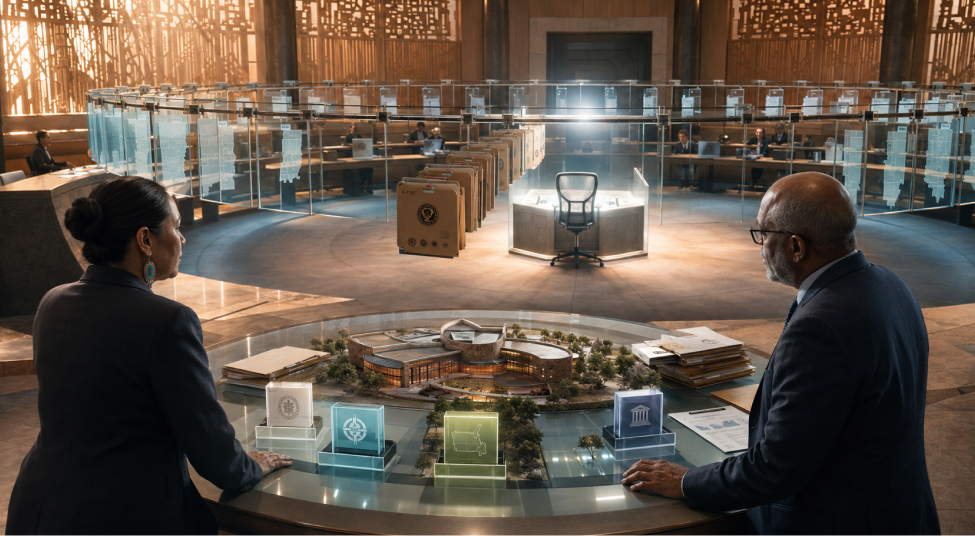
America’s federal tribal-gaming regulator has operated without an acting or permanent chair since January 13, 2026, limiting its ability to approve casino management agreements, act on tribal gaming ordinances and exercise enforcement powers assigned specifically to the chair.
The leadership vacancy at the National Indian Gaming Commission affects an industry that generated a record $46.2 billion in gross gaming revenue during fiscal 2025. The total came from 545 gaming establishments operated by 246 tribes across 29 states.
The regulatory gap does not mean tribal casinos are operating without oversight. Tribal gaming regulatory authorities remain the primary regulators of individual casinos, while state governments retain responsibilities established through tribal-state compacts. NIGC employees also continue performing administrative, technical-assistance and compliance work.
However, the commission cannot simply assign every statutory responsibility to another employee. Several consequential decisions under the Indian Gaming Regulatory Act are reserved for the NIGC chair.
That distinction is now producing practical consequences in Chandler, Oklahoma. The Iowa Tribe of Oklahoma opened the Harrah’s-branded Harrah’s Oklahoma casino on April 9, but its proposed agreement for Caesars Entertainment to assume day-to-day management remains stalled without chair-level approval.
The unresolved agreement illustrates why the vacancy is more than a Washington staffing problem. It affects how tribes structure casino operations, work with commercial partners, expand gaming enterprises and protect revenue used to support their governments and communities.
The NIGC Has Been Without A Chair Since January
Sharon M. Avery became an NIGC associate commissioner on May 6, 2024, before being appointed acting chair on May 15 of that year. Her acting-chair service concluded on January 12, 2026, and she returned to her associate-commissioner position the following day.
The commission published a bulletin on January 13 explaining how the agency would function without an acting or permanent chair. According to the NIGC leadership-vacancy bulletin, delegated authority allows certain administrative operations to continue until another acting chair is appointed or a permanent chair is confirmed.
The three-member commission subsequently underwent another leadership change. Vice Chair Jeannie C. Hovland, a member of the Flandreau Santee Sioux Tribe, left the agency on April 6. William “Billy” Kirkland was appointed as an associate commissioner for a three-year term on May 29 and is now identified by the agency as vice chair.
Kirkland’s appointment filled a commission seat but did not resolve the chair vacancy. An associate commissioner or vice chair does not automatically inherit every power that federal law gives specifically to the chair.
As of August 9, President Donald Trump had not nominated a permanent successor, according to an Associated Press investigation. A permanent NIGC chair is appointed by the president and requires Senate confirmation.
| NIGC Leadership Event | Date | Operational Effect |
|---|---|---|
| Sharon M. Avery became associate commissioner | May 6, 2024 | Filled an Interior-appointed commission position |
| Avery became acting chair | May 15, 2024 | Assumed chair-level responsibilities |
| Avery’s acting-chair term ended | January 12, 2026 | Returned to associate-commissioner status |
| Chair vacancy began | January 13, 2026 | Delegated operations continued with statutory limits |
| Jeannie C. Hovland departed | April 6, 2026 | Created another commission leadership change |
| William Kirkland joined the commission | May 29, 2026 | Filled an associate-commissioner position but not the chair |
The result is an agency that continues to operate but lacks a single official authorized to make several decisions that can determine whether a tribal gaming project, management structure or enforcement action moves forward.
The Vacancy Limits Specific Regulatory Powers
Congress created the NIGC through the Indian Gaming Regulatory Act of 1988. The federal framework was designed to support tribal economic development and self-sufficiency while establishing regulatory standards for gaming on Indian lands.
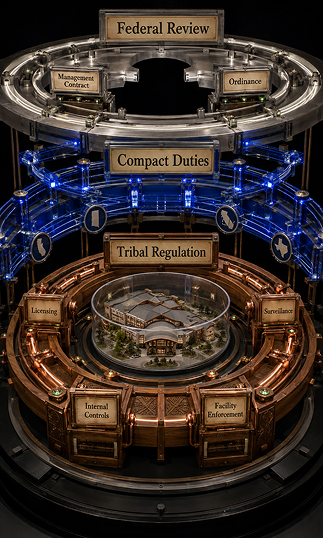
The NIGC does not replace tribal regulation. Tribal governments enact gaming laws, license facilities and establish their own regulatory bodies. For Class III casino gaming, tribes also negotiate compacts with state governments. The federal commission provides another layer of review, enforcement and technical support within that structure.
Some NIGC functions can continue under delegated authority. Staff members can conduct training, provide technical assistance, process routine submissions and maintain the agency’s administrative operations.
Other responsibilities cannot be treated as routine staff work. Federal law places important powers directly with the chair, including approval of management contracts and tribal gaming ordinances. The chair can also issue notices of violation, propose civil penalties and order temporary closure of a gaming operation in qualifying circumstances.
The agency’s management-contract guidance states that a tribe may employ an outside company to manage its gaming activity only with approval from the NIGC chair. An unapproved management contract is void, and neither the tribe nor the contractor should act under it while approval remains outstanding.
This restriction protects more than paperwork. The chair’s review considers whether contract terms comply with IGRA, whether proposed managers satisfy background and suitability requirements, and whether the arrangement protects the tribe’s ownership interests.
Chair approval is also required for tribal gaming ordinances before a new operation can open. Ordinance reviews examine issues such as ownership, revenue use, auditing, environmental protections, licensing standards and the tribe’s regulatory responsibilities.
The vacancy therefore creates separate risks at different stages of casino development. A proposed casino may have difficulty advancing an ordinance-dependent approval, while an operating property can face delays when attempting to change its management structure.
Harrah’s Oklahoma Shows The Commercial Impact
The Iowa Tribe of Oklahoma’s new casino provides the clearest example of the leadership vacancy reaching an operating gaming property.
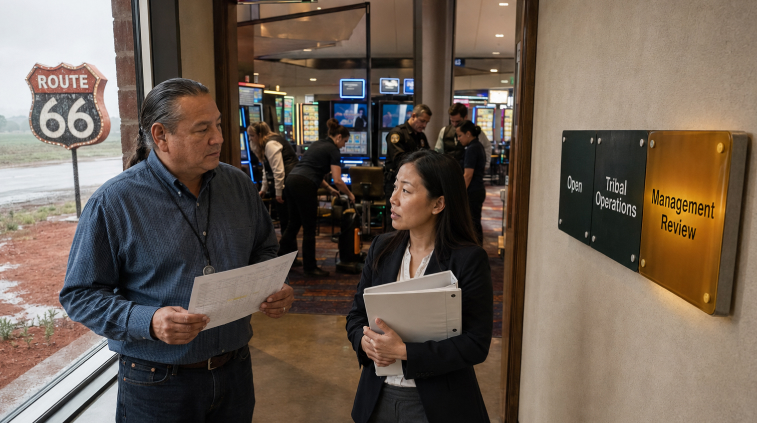
Harrah’s Oklahoma opened on April 9, 2026, along historic Route 66 in Chandler, approximately 45 miles northeast of Oklahoma City. The 175,000-square-foot property was developed through a partnership between the Iowa Tribe and Caesars Entertainment.
Opening-day demand demonstrated the commercial value of the Harrah’s brand. Iowa Tribe Chairman Jacob Keyes told the Associated Press that the property reached capacity, leaving casino employees unable to admit every arriving customer.
The branding relationship is active, and the casino is open. The unresolved issue concerns the proposed management arrangement that would allow Caesars to take over day-to-day operations.
Without an approved management contract, the tribe’s employees remain responsible for running the property. That requires a relatively small tribal-government staff to oversee a major casino operation while also handling government budgets, community programs and other public responsibilities.
The distinction between branding and management is important. A casino can display a commercial operator’s name, use licensed marketing assets or receive certain support without transferring managerial control. Day-to-day management is a more consequential legal relationship and requires NIGC chair approval.
The stalled agreement also exposes a discrepancy between commercial presentation and regulatory status. Caesars described Harrah’s Oklahoma as its first managed property in the state when announcing the opening. In practice, the proposed management contract cannot take effect until the legally required approval is granted.
That does not necessarily indicate wrongdoing by either party. It demonstrates how a federal vacancy can interrupt an otherwise planned transition after construction, recruitment, marketing and opening-day preparations have already occurred.
Tribal Casino Oversight Has Several Layers
The chair vacancy should not be interpreted as the collapse of casino regulation across Indian Country. Tribal casinos do not depend on one Washington official for every daily compliance decision.
Individual tribes maintain gaming commissions or comparable regulatory authorities responsible for licensing, surveillance standards, internal controls, investigations and facility-level enforcement. Those tribal bodies operate as regulators rather than casino management departments.
States can also perform functions negotiated through Class III gaming compacts. The precise division of responsibilities varies because compacts are negotiated separately and tribal sovereignty limits states from imposing authority beyond the agreed framework.
The NIGC supplies the federal layer. Its responsibilities include reviewing ordinances and management contracts, monitoring compliance with IGRA, collecting independently audited financial information, conducting training and taking enforcement action when serious violations remain unresolved.
This multilayered model explains why casinos can continue operating during a vacancy while important federal decisions remain frozen.
The GClubGod guide to casino compliance and responsible gaming examines how effective oversight depends on coordinated licensing, platform controls and consumer safeguards. Tribal gaming adds sovereignty, tribal law and federal Indian-gaming policy to that regulatory structure.
The absence of an NIGC chair creates a gap at the top of the federal layer. Tribal regulators can still conduct routine oversight, but they cannot approve a federal management contract or exercise authority that IGRA reserved for the chair.
That structure also means the consequences will not be identical for all 545 establishments. An established casino with no pending federal approvals may experience little immediate disruption. A tribe planning a new facility, revising an ordinance or negotiating an outside management agreement can face a much more direct obstacle.
A $46.2 Billion Industry Depends On Regulatory Continuity
The vacancy has become more significant as tribal gaming reaches record scale.
On July 21, 2026, the NIGC announced that fiscal 2025 tribal gross gaming revenue reached $46.2 billion. That represented an increase of $2.3 billion, or 5.3%, from the previous fiscal year.
The NIGC’s fiscal 2025 revenue report found growth in seven of its eight geographic regions. The total was calculated from independently audited financial statements rather than estimates of total bets or casino-floor activity.
The market is not evenly distributed. Approximately 9% of reporting operations generated more than $250 million each and collectively accounted for 56% of industry revenue. More than 54% of facilities generated less than $25 million each, representing only around 5% of total revenue.
Those differences matter when assessing the vacancy. Large operators may have more internal legal, compliance and management capacity to absorb a federal delay. Smaller tribes may depend more heavily on an experienced outside operator, a timely financing structure or a single casino project.
Gaming revenue is also different from corporate profit. Tribal governments use casino proceeds to fund public services, economic-development programs and government operations. Indian Gaming Association Chairman David Bean, a citizen of the Puyallup Tribe, has emphasized that gaming revenue supports healthcare, education, housing and other services.
A delayed management agreement can consequently affect more than the property’s commercial performance. It may change staffing demands, defer operational improvements and alter when projected revenue becomes available for government programs.
Regulatory continuity also influences lenders, development partners and technology suppliers. These organizations need predictable approval processes when evaluating project schedules and contractual obligations. An open-ended leadership vacancy introduces a timing risk that neither a tribe nor a commercial partner can resolve independently.

Enforcement Authority Cannot Be Fully Replaced
Management agreements have created the most visible business problem, but enforcement limitations present a separate concern.
IGRA authorizes the chair to levy civil fines against tribes, tribal regulatory bodies and management contractors for violations of the statute, NIGC regulations or approved tribal gaming ordinances. The chair can also order a temporary closure when statutory conditions are met.
The full commission reviews certain chair-level actions, including permanent closure decisions. Without a chair to initiate the necessary process, however, the commission cannot reproduce the same enforcement pathway simply through a vote by its remaining members.
NIGC guidance indicates that emergency authority had previously been delegated to address serious and unexpected situations. The current vacancy nevertheless leaves the agency unable to exercise the full range of ordinary chair powers, according to the AP investigation.
That does not mean violations are automatically ignored. Tribal regulators remain responsible for addressing problems within their jurisdictions, and federal criminal conduct can involve other law-enforcement agencies. NIGC personnel can also continue compliance reviews and communicate concerns.
The missing federal enforcement mechanism still matters. Independent oversight is most valuable when a problem is not resolved at the local level, when a management contractor is involved or when a violation requires a remedy explicitly assigned to the chair.
Former NIGC chair Jonodev Chaudhuri, a citizen of the Muscogee Nation, characterized the situation as the commission operating with one arm tied behind its back. His description reflects a structural limitation: the agency exists, employs staff and performs useful work, but lacks access to part of its statutory toolkit.
Prediction Markets Add Pressure To The Vacancy
The leadership gap has emerged while tribes are also challenging the growth of sports prediction markets.
Platforms offering event contracts argue that they operate as federally regulated derivatives exchanges under the Commodity Exchange Act. Tribal gaming organizations contend that sports contracts function as wagering products and can undermine tribal-state gaming compacts, consumer protections and tribal authority over gaming on Indian lands.
The legal dispute is not resolved simply by labeling the products either “trading” or “gambling.” Courts, federal regulators and lawmakers are considering how the Commodity Exchange Act interacts with state gambling laws, IGRA and tribal sovereignty.
In July 2026, David Bean testified before a House Agriculture subcommittee examining consumer protection and market integrity in sports event prediction markets. The Indian Gaming Association’s congressional statement argued that expanding these products without tribal consent threatens the regulatory framework supporting tribal government gaming.
Multiple tribes have also brought litigation against prediction-market platforms. The plaintiffs allege that contracts are being offered from tribal lands or in markets where tribal agreements establish gaming rights. The platforms dispute the allegations and maintain that their contracts fall under federal commodities jurisdiction.
The NIGC chair does not control the Commodity Futures Trading Commission or single-handedly determine the legal status of prediction markets. However, the chair normally provides a prominent federal voice on issues affecting Indian gaming.
Operating without that leader reduces the commission’s ability to represent a coordinated regulatory position while another federal framework expands into products that resemble sports wagering. The timing makes the vacancy more consequential than a routine confirmation delay.
Restoring A Chair Would Restart Decisions, Not End Every Dispute
Appointing an acting chair or confirming a permanent chair would restore access to powers that cannot currently be exercised through ordinary delegation. It would allow pending management agreements and gaming ordinances to receive authorized decisions while rebuilding the commission’s standard enforcement structure.
That would not guarantee approval of the Iowa Tribe’s proposed Caesars agreement. Chair-level review still requires examination of the contract, background information, compensation, duration and protections for the tribe. Restoring an authorized decision-maker would restart the process rather than predetermine its outcome.
A new chair would also inherit unresolved questions involving digital gaming, prediction markets, tribal-state compact rights and the division of authority among federal agencies. Those disputes will require legislation, regulatory decisions or court rulings beyond the NIGC alone.
For casino operators and platform partners, the immediate lesson is narrower. A recognizable brand, completed building and successful opening cannot substitute for a functioning approval process. Management control in tribal gaming remains subject to a legal framework designed to preserve tribal ownership and regulatory accountability.
For tribes, the vacancy creates uneven but material costs. Established properties may continue with limited disruption, while tribes pursuing new ordinances, outside management or significant operational changes face delays that can affect staffing, financing and government revenue.
The NIGC is still operating, and tribal casinos remain regulated. The disruption comes from the absence of powers concentrated by Congress in one office. Until an acting or permanent chair assumes that role, America’s $46.2 billion tribal-gaming industry will continue working around a federal oversight structure that is present but incomplete.