
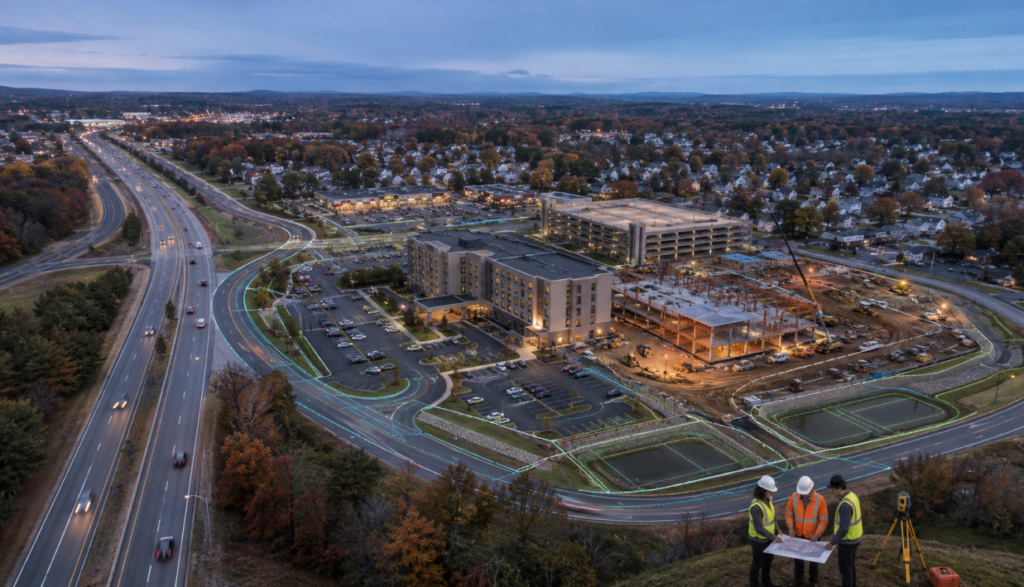
Gate City Casino’s planned move to the Sheraton Nashua property will significantly enlarge its gaming, restaurant and parking operations. It will also test how much infrastructure a casino developer should provide when a private expansion changes traffic, policing and public-service demands in a surrounding community.
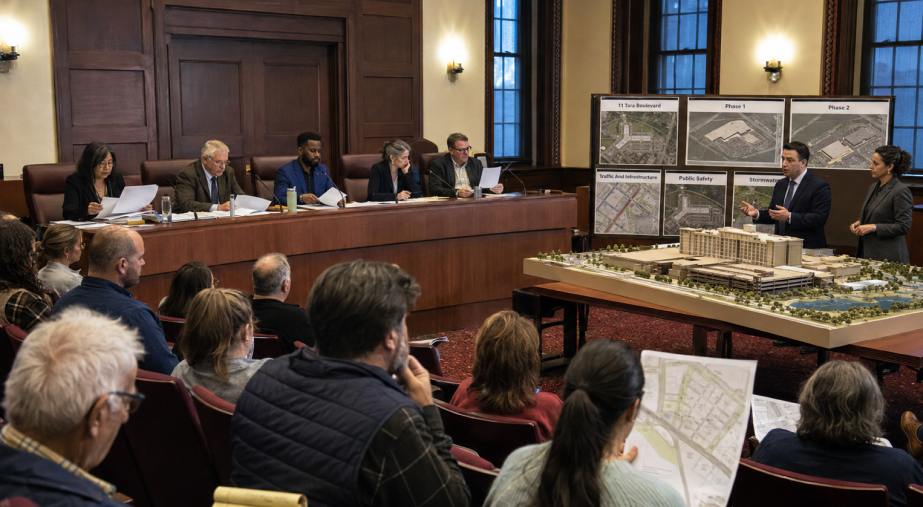
On August 6, 2026, the Nashua Planning Board considered the project during a meeting at City Hall. The board approved five separate measures covering the casino’s relocation, construction phases, waivers and development conditions.
Delaware North, operating through ARBI Farms LLC, plans to move Gate City Casino from 55 Northeastern Boulevard to the Sheraton Nashua property at 11 Tara Boulevard. Once both development phases are complete, the site is expected to contain an additional 92,860 square feet of gaming space and parking for 1,700 vehicles.
The project promises a larger regional entertainment destination near the Massachusetts border. Its approval also demonstrates that casino expansion involves more than gaming-floor economics. Roads, drainage, police coverage and neighborhood effects became central issues in determining whether the plan could advance.
Nashua Approved Five Parts Of The Development
The project went before the Nashua Planning Board on Thursday, August 6. The city’s official Planning Board meeting notice scheduled the proceeding for 7 p.m. at 229 Main Street.
The board’s approvals included a conditional-use permit allowing the casino to relocate to the hotel property, final approval for the first-phase site plan and conditional approval for the second phase. Members also voted on requested waivers and a formal definition of what would constitute active and substantial development.
Treating the plan as several connected approvals reflects its complexity. This is not simply an interior renovation or the transfer of gaming equipment from one address to another. The development changes how the property will use land, manage vehicles, support visitors and interact with surrounding roads.
Planning Board member Joe MacIntyre challenged the idea that the proposal could be understood as a routine relocation. He described it as a significant-impact development and noted that the completed project would increase gaming space by approximately 300%.
Gate City General Manager Ernie Dellaverson acknowledged the scale while emphasizing that restaurants and parking account for a substantial portion of the overall construction.
Two Phases Would Add 92,860 Square Feet Of Gaming Space
The redevelopment will occur on land currently used for parking beside the Sheraton Nashua. The existing seven-story hotel was constructed in 1979 and currently has 357 rooms, according to recent project reporting.
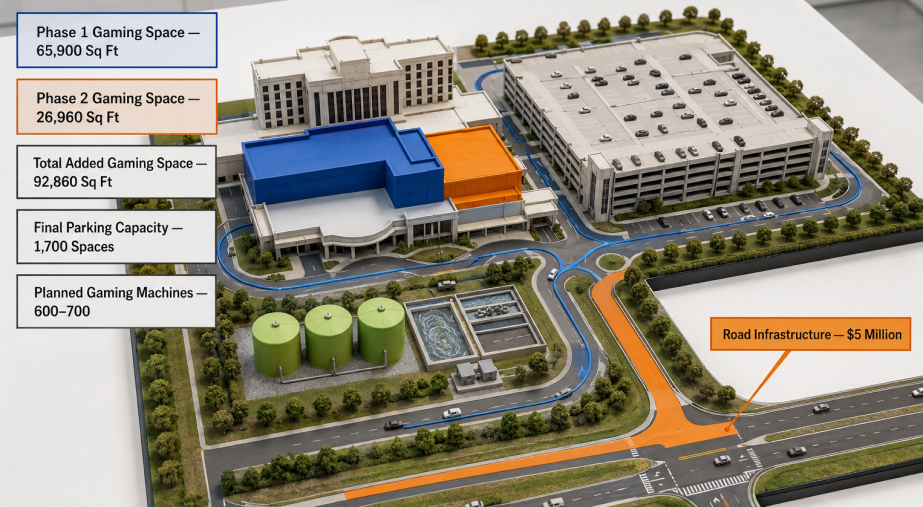
Phase 1 is expected to create 65,900 square feet of gaming space. It also includes a two-story addition, a steakhouse with private dining, an employee dining area and a five-story parking structure.
Phase 2 is projected to begin around 2030. It would add another 26,960 square feet of gaming space, plus a full-service restaurant, sports bar and Asian noodle bar.
| Project Component | Reported Plan |
|---|---|
| Phase 1 gaming space | 65,900 square feet |
| Phase 2 gaming space | 26,960 square feet |
| Total added gaming space | 92,860 square feet |
| Final parking capacity | 1,700 spaces |
| Final garage space | 480,878 square feet |
| Planned gaming-machine range | 600–700 |
| Road infrastructure commitment | $5 million |
The full property would be renamed Gate City Casino Hotel. Its combination of accommodations, gaming, food and beverage service would position it differently from a stand-alone charitable gaming venue.
The location also matters strategically. The Sheraton property sits near the Everett Turnpike and Route 3, a principal connection between New Hampshire and Greater Boston. Adding hotel rooms and restaurants to the casino experience could encourage longer visits from customers arriving from elsewhere in New England.
A $5 Million Road Plan Helped Move The Project Forward
Traffic was one of the most consequential issues during the review process.
The Planning Board had previously considered the development without a completed traffic analysis. The August approval followed a two-and-a-half-hour discussion in which developers presented a revised transportation plan and related commitments.
Attorney John Weaver, representing Delaware North, said the additional time produced a better traffic design for the applicant, casino visitors and the city.
The developer’s $5 million infrastructure commitment covers work around Tara Boulevard, its intersection with Spit Brook Road and connections to Route 3. Planned improvements include widened road sections and redesigned entrance and exit ramps.
This commitment demonstrates how the effective cost of casino development extends beyond the building. A project can be financed privately while still creating public pressure through additional traffic, road wear, emergency calls and demands on municipal personnel.
Requiring the developer to fund related improvements can shift some of those costs back to the business generating the new demand. The harder question is whether the planned work will remain sufficient after the casino reaches full operating capacity.
Parking Illustrates The Scale Of Expected Demand
The proposed parking facilities offer another measure of the project’s intended reach.
Phase 1 includes a 293,479-square-foot garage with 865 spaces. Later construction would expand the structured parking footprint, while the completed property is expected to provide 1,700 spaces across garage and surface parking.
That is a significant transportation investment for a charitable casino development. It indicates that Delaware North expects the property to attract hotel guests, restaurant customers, casino visitors and employees at the same time.
Parking capacity does not guarantee that nearby roads will operate smoothly. The timing of arrivals and departures matters, particularly during weekends, special events or peak restaurant periods. Casino traffic may also overlap with existing commuters using Route 3.
The planning process therefore had to consider more than the total number of vehicles the property could hold. Access points, intersection capacity, turn movements and the effect on surrounding neighborhoods all influence whether a large garage relieves congestion or merely stores vehicles after they pass through already-busy roads.
Police Coverage Became Part Of The Negotiation
Public safety also entered the approval discussion.
Weaver said casino ownership would be prepared to fund a third patrol officer for the area or contribute to a new police substation if Nashua officials determined that additional coverage was necessary.
That offer raises a practical governance issue. Large entertainment properties can create calls involving traffic, medical emergencies, alcohol service and crowd management. Even when incidents do not originate on the gaming floor, the concentration of visitors can affect municipal services.
Developer-funded policing can reduce the immediate cost to taxpayers. However, the arrangement needs clear limits covering funding duration, staffing control, accountability and future increases in service demand.
Police decisions must remain under public authority. A private contribution should not give a casino influence over enforcement priorities or replace transparent municipal budgeting.
The value of the commitment will ultimately depend on how it is structured, whether funding continues after construction and how Nashua measures the development’s real public-safety effects.
Stormwater Controls Address A Less Visible Cost
Drainage and water treatment received less public attention than traffic, but they are another important part of the project.
Seth Anderson of engineering and planning firm Kimley-Horn said three water-treatment stations would be added to the site. The development team is expected to coordinate with city and state regulators on stormwater and drainage requirements.
Large parking structures and expanded building footprints alter how water moves across a property. Rain that previously reached open ground or surface parking can become concentrated runoff flowing toward drains, roads and nearby properties.
Water-treatment infrastructure therefore represents more than a routine construction detail. If poorly designed, a large commercial development can increase pressure on municipal drainage systems or carry pollutants from vehicle areas into surrounding waterways.
The reported details of the approved Gate City Casino plan show that stormwater controls, traffic design and police coverage were part of the same broader negotiation. Together, they define how the project’s local costs will be managed.
Charitable Gaming Creates A Different Economic Argument
Gate City Casino operates within New Hampshire’s charitable gaming system. That structure gives casino growth a different public-policy dimension from conventional commercial casino development.
The New Hampshire Lottery reported that charitable gaming generated a record $90.4 million for local charities during fiscal year 2025. It also produced nearly $47.7 million for public education.
Those statewide figures help explain why casino expansion can attract institutional and nonprofit support. A larger property could create more gaming activity and potentially increase distributions, although the development itself cannot guarantee any specific future revenue.
The distinction matters because charitable contributions are not the same as municipal cost recovery. Money directed to nonprofit organizations or state education does not necessarily pay for a Nashua intersection, an additional patrol officer or a local drainage system.
A complete assessment must therefore consider several separate flows:
- Revenue retained by the operator
- Funds distributed through the charitable gaming framework
- State education contributions
- Local employment and business activity
- Infrastructure and public-service costs affecting Nashua
The New Hampshire Lottery’s fiscal-year results provide evidence that charitable gaming has become a substantial source of nonprofit and education funding. They do not eliminate the need for site-specific planning conditions.

The Hotel Strategy Extends The Casino’s Regional Reach
Delaware North’s plan combines gaming with overnight accommodation and multiple dining options. That model can capture more customer spending within one property and make the casino more attractive to visitors traveling from Massachusetts or elsewhere in New England.
It also reduces the distinction between a charitable gaming venue and a regional casino resort. A customer could arrive, dine, play, stay overnight and return to the gaming floor without leaving the property.
This physical expansion contrasts with digital casino growth, where operators can add customers without constructing roads, garages or hotel rooms. New Jersey’s online market, for example, recently reached approximately $276.9 million in monthly internet gaming revenue, illustrating how differently digital and land-based casino channels scale.
Online operations create their own regulatory, cybersecurity and responsible-gambling costs, but they do not generate the same immediate traffic and land-use effects. Gate City’s expansion provides a clear example of why physical casino growth must be evaluated through local infrastructure as well as gaming revenue.
More Gaming Space Requires Stronger Player Protections
The completed Gate City property is expected to accommodate approximately 600 to 700 gaming machines, up from a reported current range of 450 to 550, alongside a larger selection of tables.
More capacity can increase revenue and charitable distributions, but it also creates more opportunities for prolonged gambling. Restaurants, hotel rooms and an integrated entertainment environment may extend the amount of time visitors remain on the property.
Responsible-gambling resources should therefore scale with the gaming floor. Clear limit-setting information, visible support resources, trained employees and practical self-exclusion procedures should remain accessible throughout the expanded venue.
The design of the property matters as well. Clocks, exits, account information and help resources should not become difficult to locate inside a larger gaming environment. Expansion should be measured not only by the number of machines added but also by whether player protections remain easy to understand and use.
Nashua Will Need To Measure The Promised Benefits And Costs
Planning approval does not resolve every question surrounding Gate City Casino’s expansion. It establishes the conditions under which the project can move forward.
The next stage should involve measurable follow-through. Nashua will need to track traffic volumes, road performance, police calls, drainage effects, construction progress and compliance with the approved site plans.
The developer’s commitments are substantial: $5 million in road infrastructure, possible funding for additional policing and three water-treatment stations. Their effectiveness will depend on implementation, maintenance and whether they remain proportionate to the final scale of the property.
Gate City Casino Hotel could generate employment, tourism activity and additional charitable-gaming revenue. It could also place new demands on roads and municipal services. Both outcomes can occur simultaneously.
That is the central lesson of the Nashua approval. Casino growth cannot be evaluated only through gaming space, machine counts or projected visitors. Its full local cost becomes visible through the infrastructure and public services required to make that growth workable.