

Rush Street Interactive delivered its strongest quarterly performance to date in the second quarter of 2026, with online casino activity providing the foundation for faster user growth, higher revenue and improved operating profitability. The results illustrate why casino products—not merely sportsbook expansion—have become central to the company’s position across regulated markets in the United States, Canada and Latin America.
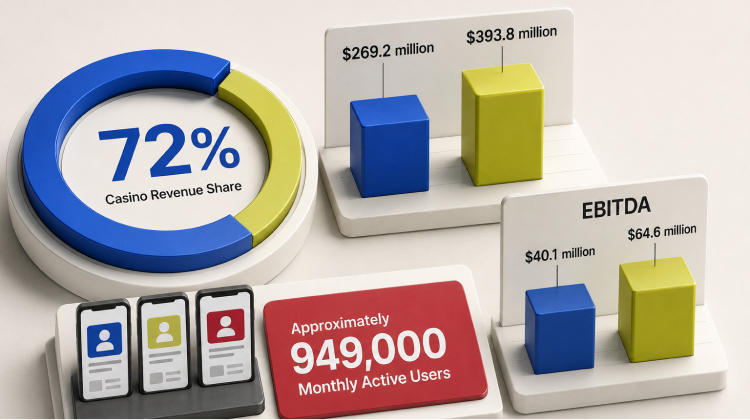
The Chicago-based operator generated record quarterly revenue of $393.8 million for the three months ended June 30, 2026. That represented a 46% increase from $269.2 million in the corresponding quarter of 2025. Adjusted EBITDA reached $64.6 million, rising 61% year over year, while net income increased to a quarterly record of $29.3 million.
Those figures are significant, but the underlying product mix is even more revealing. Online casino accounted for 72% of Rush Street Interactive’s second-quarter revenue. That concentration shows how a casino-first operating model can support recurring engagement across markets where sportsbook demand is more closely tied to individual leagues, tournaments and seasonal calendars.
Record Q2 Results Reflect More Than Market Expansion
Rush Street Interactive, commonly known as RSI, operates BetRivers, PlaySugarHouse and RushBet through its proprietary online gaming platform. According to the company’s second-quarter financial results, total monthly active users reached approximately 949,000 during Q2, an increase of 58% from the previous year.
North American monthly active users totaled approximately 296,000, up 51%. Within the company’s North American online casino markets, user growth was stronger at 64%. Latin American monthly active users, including those in Mexico, increased 62% to approximately 653,000.
| Q2 Performance Metric | 2026 Result | Year-Over-Year Change |
|---|---|---|
| Revenue | $393.8 million | 46% |
| Net income | $29.3 million | Approximately 2% |
| Adjusted EBITDA | $64.6 million | 61% |
| Total monthly active users | Approximately 949,000 | 58% |
| North American monthly active users | Approximately 296,000 | 51% |
| Latin American monthly active users | Approximately 653,000 | 62% |
The difference between user growth and revenue growth also provides useful context. Average revenue per monthly active user was $320 in North America, compared with $55 in Latin America. RSI’s geographic expansion is producing a much larger user base, but established North American markets continue to generate substantially more revenue per active customer.
That distinction matters when evaluating the durability of the quarter. Rapid registration or user growth alone does not necessarily produce sustainable casino economics. Operators must also retain players, provide a stable platform and maintain a game mix that supports repeat activity without relying excessively on short-term promotional spending.
Why Online Casino Became RSI’s Main Revenue Engine
Chief Executive Officer Richard Schwartz described the casino-first strategy as the foundation of the company’s business. Online casino’s 72% share of quarterly revenue supports that characterization and separates RSI’s operating profile from businesses that depend more heavily on sportsbook results.
Sportsbooks experience pronounced peaks around major competitions. RSI noted that its sports betting markets benefited from the 2026 World Cup during the quarter, but casino platforms can generate activity throughout the calendar. Slots, table games, live-dealer products and other digital casino categories are not restricted to a particular match or season.
Casino products can also create more frequent platform interactions. A user may visit a sportsbook only when a preferred team is playing, whereas an online casino library can provide a broader range of sessions across different game categories. The commercial value of that engagement depends on product quality, account controls and responsible design—not simply the number of games displayed. (Fantasy Football and Casino Gaming: Ultimate Guide)
This is where platform usability becomes strategically important. Navigation, search tools, loading speed, mobile stability and clear game categorization can influence whether an expanding catalog remains practical. The recent Borgata Online casino UX analysis published by GClubGod examines the same competitive pressure: larger libraries provide limited value when players cannot easily find, understand or manage their preferred content.
RSI’s proprietary technology gives the company greater control over this experience. It can coordinate casino and sportsbook products within a common account environment while adapting interfaces and payment processes to different regulated jurisdictions. That does not eliminate operational complexity, but it reduces dependence on a completely separate consumer-facing platform for every market.
User Growth Is Strong, But Retention Will Be The Bigger Test
RSI’s 64% increase in North American casino-market users indicates that the operator is acquiring or activating customers faster than its overall North American business. The next question is whether those users remain engaged as markets mature and competitive offers normalize.
The company spent an adjusted $48.6 million on sales and marketing during Q2, equivalent to 12.3% of revenue. Revenue rose faster than adjusted marketing expenditure, a potentially constructive sign for operating leverage. Adjusted EBITDA’s 61% increase, compared with revenue growth of 46%, similarly suggests that additional revenue was translating into profitability at a faster rate.
However, adjusted EBITDA is a non-GAAP performance measure. RSI defines it by excluding items including interest, income taxes, depreciation, amortization and share-based compensation. The company reported GAAP net income separately, and readers should not treat the adjusted figure as interchangeable with net income or operating cash flow.
The financial statements offer another useful measure of the platform investment required behind the growth. RSI recorded $15.7 million in internally developed software costs during the first six months of 2026, up from $13.1 million in the same period of 2025. That spending reflects the continuing importance of software infrastructure in an online casino business.
As user volume expands, the platform must process more sessions, wagers, payments and account activity without creating avoidable friction. It also needs controls capable of identifying unusual behavior, enforcing jurisdictional requirements and allowing customers to access responsible-gambling functions. Scale is therefore both a revenue opportunity and a technical test.
Geographic Expansion Adds Opportunity And Complexity
During July 2026, RSI launched online casino and online sports products in Alberta. The addition expanded a footprint that already included operations in 15 U.S. states as well as Ontario, Colombia, Mexico and Peru.
The geographic mix gives RSI multiple growth channels, but these markets are not interchangeable. Licensing rules, taxes, permitted game categories, payment systems and responsible-gambling requirements vary by jurisdiction. Player economics vary as well, as demonstrated by the sizable difference between North American and Latin American average revenue per monthly active user.

A shared platform can create efficiencies across those markets, although localization remains necessary. Language, payment preferences, game discovery and customer-service expectations can differ considerably. Operators also need to ensure that centralized technology does not produce a uniform experience that overlooks local regulatory requirements.
RSI’s guidance reflects both confidence and caution. The company raised its full-year 2026 revenue forecast to between $1.56 billion and $1.60 billion, representing expected annual growth of 38% to 41%. Adjusted EBITDA is projected at $245 million to $265 million, which would be an increase of 59% to 72%.
Those forecasts include only jurisdictions in which RSI was operating as of July 29, 2026. They also assume that the company continues operating under similar tax structures, including Colombia’s temporary emergency 16% tax decree. Changes in taxation, licensing or competitive conditions could therefore alter the financial outcome.
Responsible-Gambling Controls Must Scale With Casino Activity
A casino-first strategy creates a particular responsibility because casino products can remain available continuously rather than following a sports schedule. Higher engagement should place greater emphasis on accessible account limits, clear transaction records, reality checks, self-exclusion options and intervention systems designed to identify potentially harmful patterns.
BetRivers, PlaySugarHouse and BetRivers Canada are listed among the RG Check accredited iGaming sites maintained by the Responsible Gambling Council, with accreditation shown as valid through June 2028. The program evaluates gambling platforms against responsible-gambling standards and requires renewal rather than treating accreditation as permanent.
That distinction is important. Accreditation provides an external benchmark, but continued growth requires ongoing evaluation of how protections function in practice. A tool that is technically available may still be ineffective if it is difficult to locate, complicated to configure or separated from the parts of the platform where users make decisions. (Gotham gambles: NY sets monthly record for online sports betting)
RSI’s rising monthly active user count makes the quality and visibility of those controls more consequential. Responsible product design should develop alongside personalization, faster payments and game recommendations, rather than being treated as a separate compliance layer.

Casino Performance Will Define RSI’s Next Growth Phase
Rush Street Interactive’s second-quarter records show that its casino-first strategy is producing measurable results. Revenue, adjusted EBITDA and total users all reached new highs, while online casino generated nearly three-quarters of the company’s revenue.
The composition of that growth gives RSI a more continuous engagement engine than sports betting alone could provide. It also raises the standard the operator must meet in platform reliability, content discovery, payment security, localization and responsible-gambling oversight.
The raised 2026 guidance indicates that management expects the momentum to continue, although the forecast remains exposed to market maturity, competition, taxes and regulatory change. The most important signal in future quarters will not be whether RSI can repeat one record result. It will be whether the company can convert rapid casino-user growth into sustained, responsibly managed performance across markets with very different economics. (AI models given $10K to compete in first-of-its-kind crypto-trading competition — and most crashed and burned)