

A large US study has delivered encouraging—but carefully qualified—evidence for virtual gambling disorder treatment.
Published in JMIR Mental Health on July 24, 2026, the retrospective study examined 1,305 adults who received specialized behavioral health care through Birches Health. Researchers found that 935 participants, or 71.7% of the entire cohort, recorded a clinically meaningful reduction in gambling symptoms during treatment.
That result does not mean 71.7% of patients were cured. Improvement was defined as a reduction of at least four points on the Gambling Symptom Assessment Scale, or G-SAS. When researchers applied a stricter requirement and looked for improvement sustained across consecutive assessments, the rate fell to 47.7%.
The difference between those two percentages may be the most useful finding for clinicians, regulators and gambling operators. Virtual treatment appears capable of producing rapid symptom changes for many patients, but maintaining those gains is a separate challenge.
The Study Followed 1,305 Adults In Virtual Care
Researchers Kelsey McAlister, Elizabeth Knight, Cynthia Grant and Jennifer Huberty analyzed deidentified patient records collected between June 6, 2024, and April 20, 2026.
All participants were at least 18 years old, had received a gambling-related diagnosis under the International Classification of Diseases and had completed at least one G-SAS assessment. Their average age was 41.5, while 65.2% were male and 30.5% were female.
The peer-reviewed JMIR Mental Health study focused on the first 12 weeks of treatment. Gambling symptoms were assessed approximately once a week, allowing the researchers to examine both the scale of improvement and how quickly it occurred.
| Study Measure | Reported Result |
|---|---|
| Total participants | 1,305 |
| Participants with at least one follow-up | 1,071, or 82.1% |
| Clinically meaningful improvement | 935, or 71.7% of the full cohort |
| Sustained improvement | 622, or 47.7% of the full cohort |
| Median time to initial improvement | 14 days |
| Estimated G-SAS reduction over 12 weeks | 8.3 points |
| Average treatment sessions | 12.88 |
| Median treatment sessions | 9 |
The size of the cohort distinguishes this research from many earlier gambling-treatment studies. It also reflects routine clinical care rather than a tightly controlled experimental program, providing a view of how specialized virtual services may function outside a traditional trial.
What The 71.7% Improvement Rate Actually Means
The headline figure requires context.
The G-SAS is a validated clinical questionnaire used to measure gambling urges, thoughts, behaviors and related consequences. Participants entered treatment with an average score of 20.5, placing the average patient in the scale’s moderate symptom range.
Researchers defined clinically meaningful improvement as a decrease of four or more points. Of the 1,305 participants, 935 reached that threshold at some point during the 12-week analysis period. The median time required to reach it was 14 days.
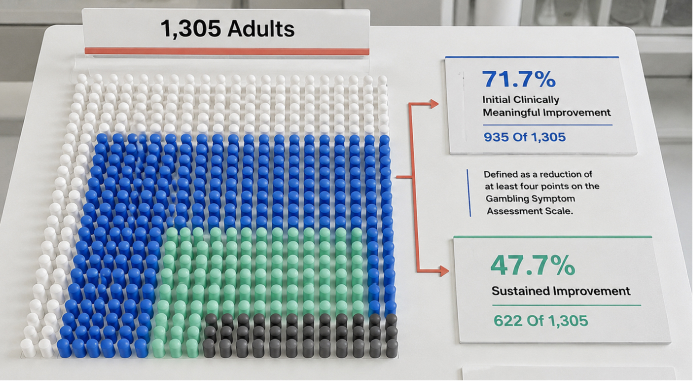
However, only 622 patients—47.7% of the full cohort—maintained that improvement at a consecutive assessment.
That gap does not erase the initial result. It shows why “improved” should not be interpreted as “recovered,” “cured” or permanently free from gambling-related harm. A patient can reach a meaningful clinical threshold and later experience renewed urges, behaviors or consequences.
The study’s authors identified maintaining early gains as a particular challenge. They suggested that virtual care programs may benefit from more structured phases and longer-term monitoring designed to support sustained recovery.
Gambling Symptoms Declined Across The 12-Week Period
The study found that G-SAS scores decreased by an estimated 0.099 points per day. Over 12 weeks, that translated into an average modeled reduction of approximately 8.3 points.
Patients who achieved the four-point improvement threshold often did so early. The population-wide model estimated a 2.8-point decrease over the first four weeks, while the median patient classified as improved reached the required reduction in only 14 days.
Those findings measure different things. The population estimate includes patients regardless of whether they responded strongly, slowly or not at all. The 14-day figure applies to those who eventually crossed the study’s improvement threshold.
Early progress could be influenced by regular patient contact, continuous symptom monitoring, a decision to seek help during a period of acute distress or the treatment itself. Because the research did not include an untreated comparison group, it cannot determine how much of the change was caused by any single factor.
The most defensible interpretation is that symptom improvement was associated with participation in the virtual care program. The study does not establish that virtual treatment alone caused every reduction.
Virtual Care Included More Than Video Therapy
Participants were not simply given access to a generic video-calling service. Birches Health delivered synchronous care through secure video sessions with licensed, master’s-level clinicians trained in gambling disorder and behavioral addictions.
Treatment plans were individualized and could include cognitive behavioral therapy, motivational interviewing and relapse-prevention strategies. Depending on a patient’s needs, the wider care model could also incorporate group therapy, peer services and financial wellness counseling.
Appointments generally occurred weekly or every two weeks. Treatment goals were based on the patient’s circumstances and could involve abstinence, reducing harm or improving everyday functioning.
Participants completed an average of 12.88 sessions, although the median was nine. The range—from one to 76 sessions—shows that patients did not all receive the same treatment intensity.
That variation is important. The research evaluates a multicomponent care system, not one standardized intervention administered identically to every participant. It therefore cannot establish whether cognitive behavioral therapy, clinician specialization, peer support, financial counseling or another element produced the strongest effect.
The National Council on Problem Gambling’s treatment overview similarly explains that assistance may involve professional counseling, peer support and other resources selected according to individual needs.
More Than Half Had Another Psychiatric Diagnosis
The patients represented a clinically complex population. Approximately 56% had at least one recorded psychiatric comorbidity.
Anxiety disorders were the most common, affecting 26.9% of the cohort. Depressive disorders were recorded for 21.1%, followed by trauma- and stress-related disorders at 9.6%, substance use disorders at 6.5% and attention-deficit/hyperactivity disorder at 5.1%.
The relationships between those conditions and gambling improvement were not uniform.
Higher depression symptom scores at treatment entry were associated with faster reductions in gambling symptoms. Yet having a formal depressive disorder diagnosis was associated with a slower improvement trajectory. Patients with ADHD also improved more slowly, while those with a substance use disorder entered care with more severe gambling symptoms on average.

Researchers cautioned against drawing causal conclusions from these patterns. A current symptom score and a diagnosed psychiatric condition do not measure precisely the same thing. Depression, ADHD, substance use and gambling problems may also interact differently from one patient to another.
The results support an individualized approach. A virtual service may remove distance and scheduling barriers, but clinical complexity does not disappear when treatment moves online.
Remote Access Could Reduce Treatment Barriers
Virtual treatment may be particularly relevant in states or communities where clinicians specializing in gambling disorder are difficult to reach.
Patients can attend sessions without traveling to a clinic, potentially reducing transportation problems, time conflicts and concerns about being recognized at a treatment facility. A remote format can also connect people with specialized providers who are not located in their immediate community.
The study’s female participation rate offers one potentially meaningful signal. Women represented 30.5% of the cohort. The authors noted that women may face treatment barriers involving stigma, shame, gender expectations and limited social support. They suggested that virtual access and services such as a dedicated women’s gambling support group may have helped engagement.
That remains a plausible explanation rather than a tested conclusion. The study did not compare virtual and in-person recruitment directly, and it lacked race and ethnicity data. It therefore cannot establish whether access or outcomes were equitable across different demographic groups.
Still, expanding access to specialized help matters as legal sports betting, mobile casino products and prediction-style markets increase the number of gambling opportunities available from a phone. Responsible-gambling systems should connect warnings and account controls to meaningful routes into care, a principle also reflected in GClubGod’s coverage of responsible gaming and compliance for live sports betting casinos.
The Study Has Significant Limitations
The research offers real-world evidence, but several limitations prevent it from proving that the Birches Health program caused the reported improvements.
First, there was no control group. Symptom reductions could reflect treatment, natural recovery, regression to the mean, changes in financial access, self-exclusion or other events not isolated by the study.
Second, 234 participants—17.9% of the cohort—did not complete a follow-up gambling assessment. The researchers reported no significant baseline demographic or clinical differences between patients with and without follow-up data, but missing assessments can still affect response estimates.
Third, the analysis covered only 12 weeks. It does not show whether improvements lasted for six months, one year or longer, nor does it fully measure disengagement or relapse after treatment.
The researchers also lacked race and ethnicity information and did not model possible differences between therapists. Concurrent medication and the separate effects of individual treatment components were not evaluated.

Financial relationships deserve disclosure as well. The paper reported no external study funding, but Birches Health supplied the data through a scientific partnership with Fit Minded Inc. Fit Minded received compensation for serving as Birches Health’s embedded scientific team. Cynthia Grant is employed by Birches Health, Jennifer Huberty is Fit Minded’s founder and CEO, and McAlister and Knight are Fit Minded employees.
Those relationships do not invalidate the results, but they strengthen the case for independent replication and randomized comparisons.
The Strongest Result May Be The Gap Between Early And Sustained Gains
The 71.7% figure shows that a large share of this treatment-seeking cohort experienced a measurable reduction in gambling symptoms. The 47.7% sustained-improvement rate shows how much harder it may be to preserve that progress.
Future studies will need to determine whether virtual care performs as well as, or better than, in-person treatment for comparable patients. Longer follow-up periods could establish how frequently early improvement translates into sustained recovery, while randomized trials could separate treatment effects from other influences.
Research should also identify which components matter most. If frequent monitoring, specialist access, cognitive behavioral strategies or financial counseling produce different benefits, care providers could allocate resources more effectively.
For gambling operators and regulators, the study supports looking beyond pop-up warnings and deposit-limit menus. Identifying risk is only the beginning. Effective responsible-gambling infrastructure also requires clear, private and practical routes from digital gambling environments to qualified support.
For individuals, the results provide evidence that improvement during virtual care is possible, including among patients with complex mental health profiles. They do not guarantee a particular outcome or replace assessment by a qualified professional.