
The New York Yankees named Polymarket an official prediction-market partner on August 6, 2026, giving the platform a prominent position at Yankee Stadium during the closing months of the Major League Baseball season.
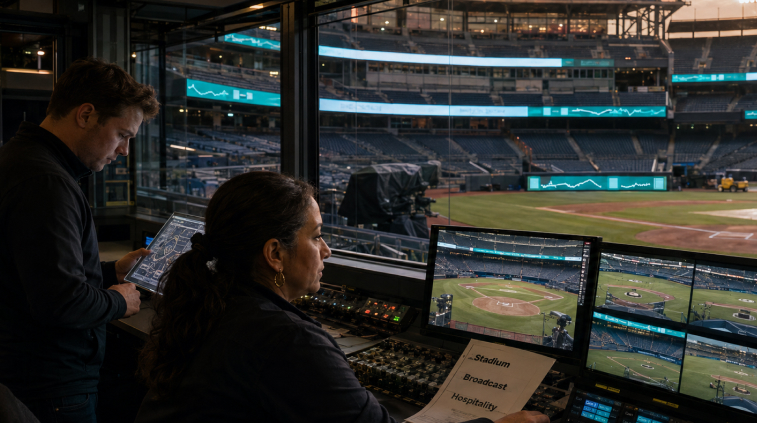
The agreement will place Polymarket branding on LED displays before and during home games. Rotating signage behind home plate will also appear during locally televised Yankees games on YES Network and Prime Video.
Polymarket will receive premium hospitality inventory and participate in selected fan experiences. The partnership expands a sports portfolio that already includes MLB, the Bundesliga and Liga MX.
For the Yankees, the deal adds a new category of digital partner during the club’s postseason push. For Polymarket, it connects a federally regulated event-contract business with one of the most recognizable teams in American sports.
The agreement is commercially significant, but it also arrives during a dispute over how sports prediction markets should be classified and regulated. Polymarket US operates as a Commodity Futures Trading Commission-regulated exchange, while New York maintains a separate state-licensed sports-wagering system.
The Yankees partnership does not resolve that divide. Instead, it places prediction-market branding directly inside the country’s largest regulated mobile sports-betting market while state and federal authorities continue debating where these platforms belong.
Polymarket Branding Is Coming To Yankee Stadium
The partnership covers the remainder of the 2026 MLB season. According to the official Polymarket announcement, its branding will appear throughout Yankee Stadium before and during Yankees games.
The agreement includes rotating home-plate signage visible on YES Network and Prime Video broadcasts. That placement gives Polymarket exposure beyond spectators inside the Bronx venue, reaching viewers across the Yankees’ regional and streaming audiences.
The sponsorship package also includes access to Ford Field MVP Club tickets and single-game luxury suites. Announced fan experiences include an outfield catch for children, Kids Run the Bases and lineup-card delivery opportunities.
| Partnership Element | Announced Structure |
|---|---|
| Announcement date | August 6, 2026 |
| Duration | Remainder of the 2026 MLB season |
| Stadium branding | LED displays before and during games |
| Broadcast visibility | Home-plate signage on YES Network and Prime Video |
| Hospitality | Ford Field MVP Club tickets and luxury suites |
| Fan experiences | Outfield catch, Kids Run the Bases and lineup-card delivery |
| Wider relationship | Builds on Polymarket’s MLB partnership |
Michael Tusiani, the Yankees’ senior vice president of partnerships, said the club expects the stadium signage and fan experiences to increase Polymarket’s visibility across its fan base.
Ari Borod, Polymarket’s president of sports business development, described Yankees supporters as some of the platform’s most active sports users. The companies did not disclose the financial value of the team agreement.
The partnership should therefore be understood primarily as a branding, hospitality and fan-engagement arrangement. The announcement did not say that the Yankees will operate prediction markets, share trading revenue or integrate contracts into the team’s official mobile application.
The Deal Builds On Polymarket’s MLB Partnership
The Yankees agreement did not emerge in isolation. On March 19, 2026, Major League Baseball named Polymarket its official and exclusive Prediction Market Exchange partner.
That league-level agreement gives Polymarket and its brokers access to MLB names, marks and logos inside prediction-market products. It also provides access to official league data supplied through Sportradar, MLB’s exclusive global distributor of data for prediction markets.
Polymarket receives exposure across MLB’s digital services and at league events. The Yankees deal adds a club-specific layer through stadium inventory, local broadcasts, premium hospitality and direct fan experiences.
The GClubGod analysis of New York live betting platforms explains why major events are especially valuable to wagering and prediction products. High-interest games concentrate user activity, increase demand for live information and expose weaknesses in pricing, settlement and platform reliability.
For Polymarket, the Yankees provide an established audience with an unusually strong connection to baseball history, media and postseason expectations. Stadium branding can introduce the prediction-market category to fans who may recognize traditional sportsbooks but remain less familiar with event contracts.
MLB also gains a formal relationship with an increasingly visible part of the sports market. Prediction contracts already exist around game winners, championship outcomes and other baseball events. Working directly with an exchange gives the league more influence over official data, permitted market categories and integrity communication than it would have by remaining outside the sector.
That influence does not eliminate risk. A league partnership can make a prediction platform appear more established or officially endorsed, which increases the importance of clearly explaining what the product is, who regulates it and which consumers can use it.
Prediction Markets Are Not Conventional Sportsbooks
Prediction markets and sportsbooks can offer products tied to the same baseball game, but their structures are different.
A conventional sportsbook sets wagering prices, accepts bets and manages its exposure to different outcomes. A prediction exchange allows participants to buy and sell contracts whose value depends on whether a specified event occurs. Market prices can be interpreted as collective estimates of an outcome’s probability, although those prices can also be affected by liquidity, trader behavior and contract design.
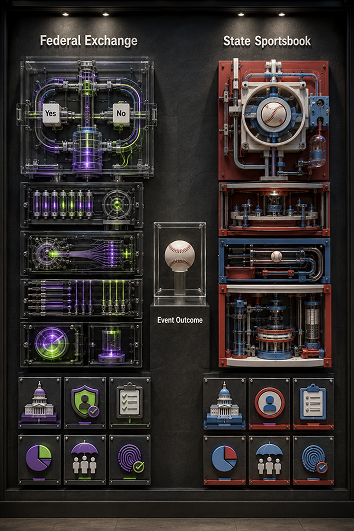
Polymarket US operates through QCX LLC. The CFTC’s official registration record lists QCX as a designated contract market operating under the Polymarket US name. The designation dates to July 9, 2025.
That federal status is central to Polymarket’s position in the United States. Its event contracts are offered through a framework established under the Commodity Exchange Act rather than a conventional state sportsbook license.
New York’s regulated mobile sportsbooks operate differently. Mobile wagers placed in the state are transmitted to licensed commercial casinos, and sportsbook gross gaming revenue is taxed at 51 percent.
The New York sports-wagering framework currently lists licensed brands including FanDuel, DraftKings, Caesars Sportsbook, BetMGM, Fanatics Sportsbook, Bally Bet, ESPN Bet, Resorts World Bet and Rush Street Interactive. State wagering taxes support public education, problem-gambling services and youth sports programs.
Polymarket is not listed among those state sportsbook operators. Its CFTC designation should not be confused with a New York mobile sports-wagering license, just as the Yankees partnership should not be interpreted as one.
Users need to evaluate the applicable product, exchange, broker, contract rules and jurisdictional restrictions before participating. A familiar team logo or stadium advertisement does not replace the platform’s terms or determine an individual user’s eligibility.
MLB Has Created A Prediction-Market Integrity Framework
Baseball’s primary concern extends beyond sponsorship inventory. Prediction contracts can create integrity risks when markets are based on events that a player, manager, umpire or other participant may be able to influence.
MLB’s March agreement with Polymarket includes restrictions on markets involving individual pitches, managerial decisions and umpire performance. Those categories are considered especially sensitive because they can depend on a single person’s discretionary action rather than the broader outcome of a game.
Polymarket agreed to integrate MLB-related integrity controls into its U.S. rulebook. The protections are intended to apply across brokers providing access to the exchange rather than only through one front-end platform.
Commissioner Robert D. Manfred Jr. also signed a memorandum of understanding with CFTC Chairman Michael S. Selig. The MLB prediction-market agreement establishes confidential information sharing and regular discussions about activity that could affect baseball or related event contracts.
MLB said it intends to maintain integrity relationships with other exchanges offering baseball contracts, even though Polymarket receives exclusive commercial rights as the league’s official partner.
This distinction matters. Commercial exclusivity determines which company can use specific MLB branding and partnership assets. Integrity monitoring must cover a wider market because suspicious activity could occur on any exchange offering baseball contracts.
Useful controls may include restrictions on sensitive contract types, monitoring for unusual trading, rules governing people with access to confidential information and rapid communication when a league investigation begins.
These systems cannot guarantee that every risk will be detected. Their effectiveness will depend on how quickly trading data can be analyzed, how consistently rules are applied across brokers and whether questionable contracts are restricted before they create an integrity problem.
The New York Partnership Arrives During A Legal Conflict
The location of the Yankees partnership gives the announcement additional regulatory importance.
On July 31, 2026, Governor Kathy Hochul and Attorney General Letitia James announced that New York had filed a lawsuit against KalshiEX LLC, one of Polymarket’s principal prediction-market competitors.
The state alleges that Kalshi is operating an unauthorized sports-gambling business and avoiding requirements imposed on licensed sportsbooks. New York is seeking an injunction, customer restitution, disgorgement and civil penalties.
Kalshi argues that its event contracts are federally regulated derivatives under exclusive CFTC jurisdiction. The case had not produced a final judgment when the Yankees announced their Polymarket partnership.
The New York action against Kalshi does not name Polymarket as a defendant. It would therefore be inaccurate to state that New York has sued Polymarket or legally invalidated the Yankees agreement.
Nevertheless, the case challenges the broader regulatory theory on which sports prediction exchanges depend. If New York establishes that sports event contracts are subject to its gambling laws, the effects could extend beyond a single company.
The dispute concerns more than terminology. New York argues that its sportsbook system includes state licensing, a minimum participation age of 21, tax collection, consumer protections and responsible-gambling obligations that federally regulated exchanges may approach differently.
Prediction platforms maintain that designated contract markets are already subject to federal oversight, exchange rules, surveillance and financial-market requirements. Courts and regulators are now being asked to determine how those federal responsibilities interact with state gambling authority.
The Yankees’ decision to partner with Polymarket does not settle that issue. A commercial sponsorship can continue while the legal status of particular products, contracts or access methods remains contested.
Youth-Facing Experiences Require Clear Separation
The inclusion of children’s activities in the sponsorship package creates a separate brand-safety question.
Kids Run the Bases, lineup-card delivery and an outfield catch are ordinary baseball experiences rather than prediction contracts. However, placing them within a partnership involving a prediction-market company requires clear separation between family programming and any product connected to financial risk or sports outcomes.
The announcement does not say that children will trade contracts, receive accounts or view transactional demonstrations. It would be inappropriate to infer those activities without evidence.
Even so, the structure of the agreement means the Yankees and Polymarket will need careful rules for signage, data collection, promotional language and digital follow-up associated with youth-oriented events.
The distinction should be visible rather than buried in terms. Family experiences should not include calls to trade, account-registration prompts or presentation of event contracts as a children’s game.
This is also an interface issue. Prediction-market branding often relies on probabilities, questions and changing prices that can resemble familiar sports statistics. Platforms should explain when a display is informational and when an action creates a financial position.
The same principle applies to adults. Team affiliation can increase recognition, but it should not be treated as an assurance that a contract is appropriate, profitable or available in every jurisdiction. Sports outcomes remain uncertain, and contract prices do not guarantee accurate forecasts.
Polymarket Gains More Than Stadium Exposure
Yankee Stadium signage gives Polymarket immediate visibility, but the larger strategic benefit is association with an established American sports institution.
Prediction exchanges are competing not only for users but also for legitimacy, official data and recognizable distribution channels. Partnerships with MLB and the Yankees help position Polymarket alongside conventional sports-media and sponsorship categories rather than as an external market operating without league involvement.
Official Sportradar data may also improve consistency when baseball contracts are listed, monitored and settled. Reliable event definitions and results are especially important when markets depend on specific game events or season outcomes.
For the Yankees, Polymarket adds a technology-focused commercial partner without requiring the club to build an exchange. The organization can sell stadium exposure and hospitality while relying on MLB’s broader relationship for league data and integrity coordination.
There are also reputational risks. Legal challenges, disputed settlements, unsuitable market categories or weak consumer controls could reflect on the team even if the Yankees do not operate the platform.
The partnership’s value will therefore depend on more than impressions generated by LED boards. Clear market rules, reliable settlement, responsible advertising, secure account controls and effective integrity monitoring will determine whether the relationship feels credible after its initial announcement.
The Yankees Deal Tests Prediction Markets In A Sportsbook State
New York has become one of the most important regulated sports-wagering markets in the United States. The state publishes weekly and monthly operator results, taxes sportsbook revenue at 51 percent and limits mobile wagering to approved platforms connected to licensed casinos.
Against that background, the Yankees–Polymarket agreement creates an unusual contrast. Fans will see prediction-market branding inside a New York stadium even though Polymarket is not part of the state’s conventional sportsbook list.
That contrast will make consumer education essential. A prediction contract may resemble a sports bet economically, but the platform, pricing mechanism, oversight structure, eligibility standards and legal arguments can differ.

The agreement could help Polymarket reach a large baseball audience during the most commercially valuable part of the season. It could also intensify scrutiny of how prediction exchanges advertise, structure sports markets and distinguish themselves from sportsbooks.
MLB has attempted to address the integrity side through sensitive-market restrictions, official data and information sharing with the CFTC. The New York litigation against Kalshi shows that state concerns about licensing, age limits, taxation and consumer protection remain unresolved.
Polymarket’s presence at Yankee Stadium is consequently more than another sponsorship activation. It is a visible test of whether prediction markets can become normalized within American professional sports while their regulatory boundaries are still being contested.
For the Yankees and Polymarket, brand exposure begins immediately and continues through the remainder of the 2026 season. The more important result will take longer to measure: whether commercial growth, consumer clarity and baseball integrity can advance together under a framework that both federal and state authorities accept.